State paycheck estimator

North Carolina Paycheck Calculator

Estimate your North Carolina take-home pay per paycheck: federal tax, FICA, state income tax, plus pre-tax 401(k) and health deductions. Single-filer 2026 model; nothing you enter leaves your browser.

Direct answer

What does this tool do?

North Carolina Paycheck Calculator computes the result directly in your browser — Estimate your North Carolina take-home pay per paycheck: federal tax, FICA, state income tax, plus pre-tax 401(k) and health deductions. Single-filer 2026 model; nothing you enter leaves your browser. Nothing you enter is uploaded or stored.

Tax year 2026 · State rate verified 2026-09-12 against the state's own document: ncdor.gov Tax Rate Schedules - 3.99% for tax years after 2025 (4.25% for 2025) · Informational, not tax advice.

The big picture

How a North Carolina paycheck breaks down

North Carolina taxes wages at a flat 3.99%. Federal income tax uses 2026 single-filer brackets with the $16,100 standard deduction; FICA is 6.2% Social Security (up to $184,500 of wages) plus 1.45% Medicare.

Calculator

Estimated take-home per paycheck

-

-

LinePer paycheck
Gross-
Pre-tax deductions-
Federal income tax-
State income tax-
FICA (SS + Medicare)-

Effective combined income-tax rate: -

How the state tax is sliced

RateTaxed sliceTax

Single-filer illustration with the standard deduction; excludes credits, exemptions, retirement catch-ups, and local/city taxes. State rate verified 2026-09-12 against the state's own document: ncdor.gov Tax Rate Schedules - 3.99% for tax years after 2025 (4.25% for 2025) Tax year 2026; verify with the North Carolina revenue department. Not tax advice.
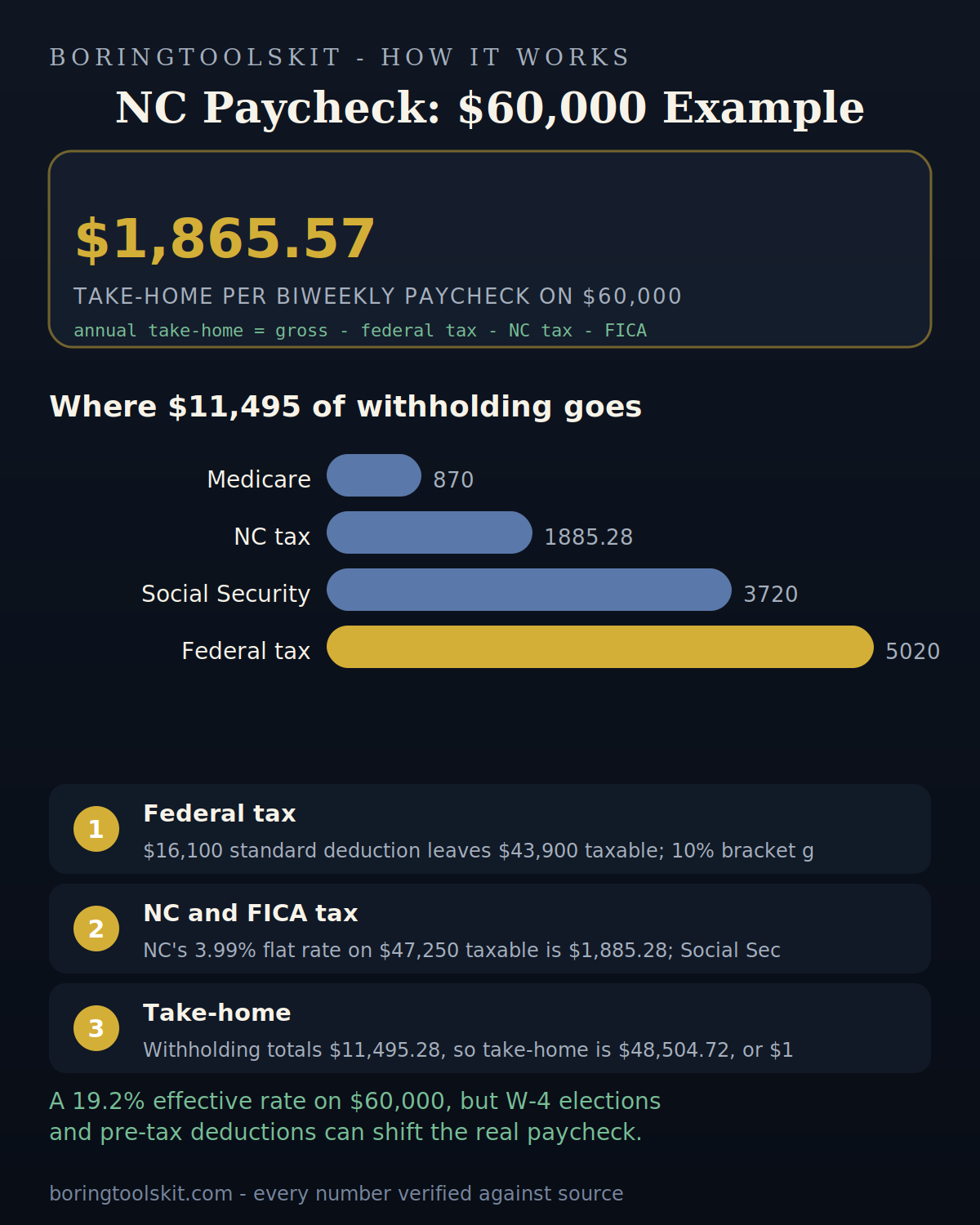
Infographic: how North Carolina take-home pay is calculated for tax year 2026 — the state income tax, federal tax and FICA, and the resulting per-paycheck amount.
How North Carolina take-home pay is calculated for tax year 2026, using the state rate verified against North Carolina's own revenue-department document on 2026-09-12.
Methodology

How this estimate works

Annual gross minus pre-tax 401(k)/health contributions minus the standard deduction is taxed through the 2026 federal single-filer brackets. Social Security takes 6.2% of gross wages up to $184,500; Medicare takes 1.45% of all wages (0.9% additional above $200,000 single). State income tax applies the North Carolina table to wages after pre-tax deductions. Everything divides by your pay frequency.

See the full North Carolina bracket table or the federal paycheck calculator.

Use this result

Share the current inputs or ask ChatGPT to explain the calculation in context.

More options
Report a calculation issue

Worked example: $60,000 salary, paid biweekly

Take a single filer earning $60,000 with no pre-tax deductions, paid every two weeks (26 paychecks). Federal first: the $16,100 standard deduction leaves $43,900 taxable. The 10% bracket covers the first $12,400 for $1,240, and the 12% bracket takes 12% of the remaining $31,500, which is $3,780. Federal income tax totals $5,020.

North Carolina applies its 3.99% flat rate after its own $12,750 standard deduction, so $47,250 is taxable: 47,250 x 0.0399 = $1,885.28 for the year. FICA is separate and ignores deductions in this example: Social Security takes 6.2% of $60,000 ($3,720) and Medicare takes 1.45% ($870), for $4,590.

Total withholding is $5,020 + $1,885.28 + $4,590 = $11,495.28, so annual take-home is $48,504.72. Divided across 26 paychecks that is $1,865.57 per check, an effective combined income-tax rate of 19.2%. The calculator reproduces each of these lines, which is what the per-paycheck breakdown table shows.

Where the estimate drifts from a real paycheck

The biggest gap is W-4 elections. The example taxes exactly the standard deduction, but an employee claiming single with no adjustments on the W-4 can have more withheld than the formula implies, because the employer's withholding tables front-load tax into earlier paychecks rather than spreading it evenly. Someone who started mid-year after a higher-paying job often sees overwithching of several hundred dollars that only returns as a refund.

Pre-tax deductions move more than their face value. A $300 monthly health premium and 5% into a 401(k) on the same $60,000 salary cut federal taxable income by $6,600 a year, saving roughly $792 in federal tax at 12% plus $263 in North Carolina tax, while Social Security still applies to the full gross. The calculator models this; a paper paycheck stub may slice the 401(k) per pay period instead, which shifts pennies of rounding.

Two hard edges: wages above $184,500 stop accruing Social Security mid-year, so a $200,000 earner's December checks are visibly larger than the per-paycheck average, and the second job trap means each employer withholds as if it were the only one, almost always undershooting total tax.