Estimate your New Jersey take-home pay per paycheck: federal tax, FICA, state income tax, plus pre-tax 401(k) and health deductions. Single-filer 2026 model; nothing you enter leaves your browser.
Direct answer
What does this tool do?
New Jersey Paycheck Calculator computes the result directly in your browser — Estimate your New Jersey take-home pay per paycheck: federal tax, FICA, state income tax, plus pre-tax 401(k) and health deductions. Single-filer 2026 model; nothing you enter leaves your browser. Nothing you enter is uploaded or stored.
Tax year 2026 · This state's brackets are an unverified planning estimate — they have not been checked against the New Jersey revenue department's current 2026 withholding tables and may be stale. · Informational, not tax advice.
The big picture
How a New Jersey paycheck breaks down
New Jersey has 7 graduated income-tax brackets (top 10.75%). Federal income tax uses 2026 single-filer brackets with the $16,100 standard deduction; FICA is 6.2% Social Security (up to $184,500 of wages) plus 1.45% Medicare.
Calculator
Estimated take-home per paycheck
-
-
Line
Per paycheck
Gross
-
Pre-tax deductions
-
Federal income tax
-
State income tax
-
FICA (SS + Medicare)
-
Effective combined income-tax rate: -
How the state tax is sliced
Rate
Taxed slice
Tax
Single-filer illustration with the standard deduction; excludes credits, exemptions, retirement catch-ups, and local/city taxes. This state's brackets are an unverified planning estimate — they have not been checked against the New Jersey revenue department's current 2026 withholding tables and may be stale. Tax year 2026; verify with the New Jersey revenue department. Not tax advice.
How New Jersey take-home pay is calculated for tax year 2026. The state brackets shown are an unverified planning estimate, not a verified 2026 withholding table.Methodology
How this estimate works
Annual gross minus pre-tax 401(k)/health contributions minus the standard deduction is taxed through the 2026 federal single-filer brackets. Social Security takes 6.2% of gross wages up to $184,500; Medicare takes 1.45% of all wages (0.9% additional above $200,000 single). State income tax applies the New Jersey table to wages after pre-tax deductions. Everything divides by your pay frequency.
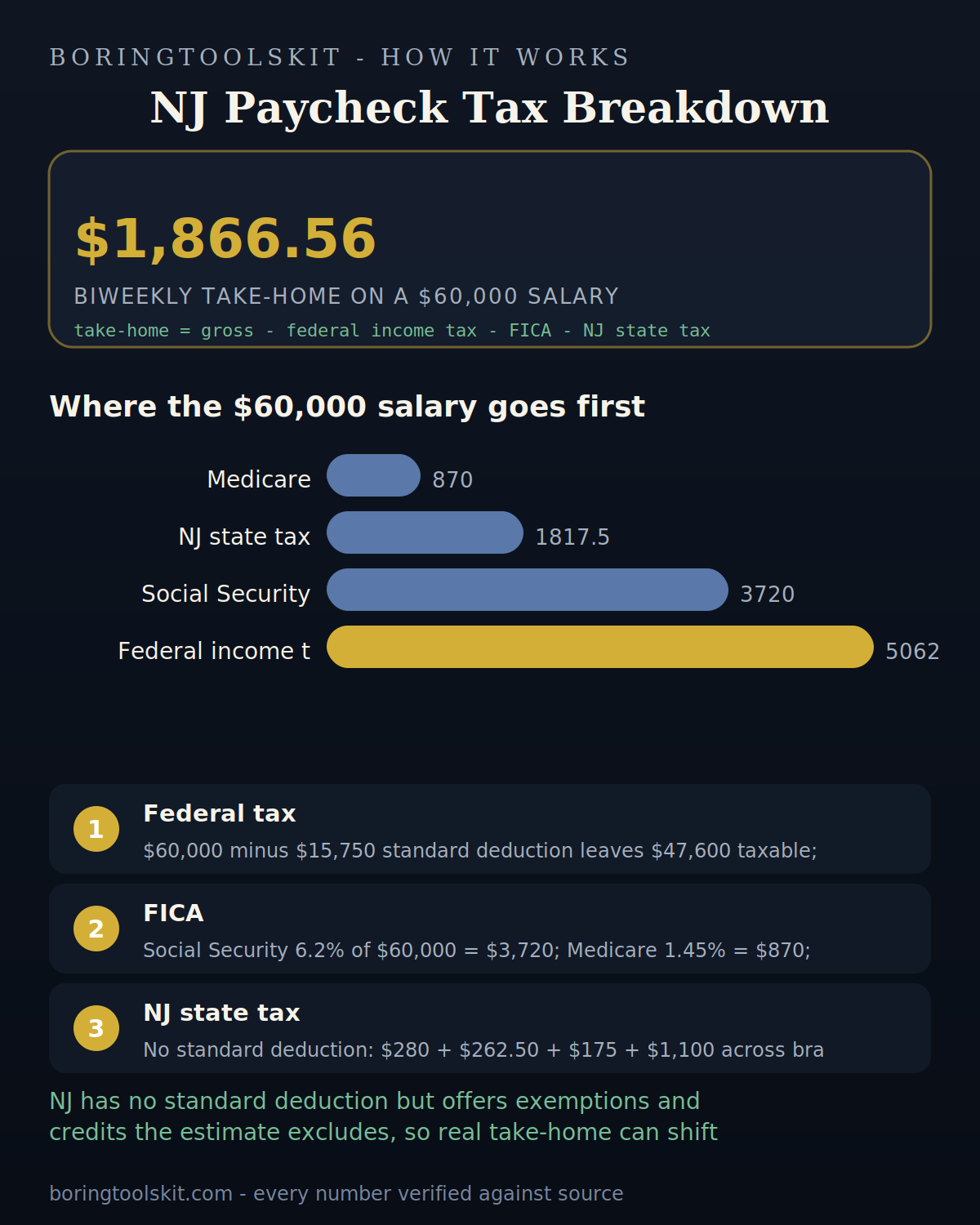
Take a single filer with a $60,000 salary, no 401(k) or health premium, paid every two weeks (26 paychecks). The federal side starts by subtracting the standard deduction: $60,000 minus $15,750 leaves $47,600 taxable. The first $12,400 is taxed at 10% ($1,240) and the remaining $35,200 at 12% ($3,822), so federal income tax is $5,062 per year.
FICA ignores the standard deduction entirely: Social Security takes 6.2% of the full $60,000 ($3,720, well under the $184,500 wage base) and Medicare takes 1.45% ($870). That is $4,590 before state tax is even mentioned.
New Jersey taxes wages without a standard deduction, so the full $60,000 runs through the state table: 1.4% on the first $20,000 ($280), 1.75% on the next $15,000 ($262.50), 3.5% on the next $5,000 ($175), and 5.5% on the next $20,000 ($1,100), totaling $1,817.50 per year. All taxes combined come to $11,469.50, leaving $48,530.50 of take-home for the year, or $1,866.56 per biweekly paycheck. The combined federal-plus-state income-tax bite is $6,879.50, an effective rate of about 11.47% of gross.
Where this estimate drifts from a real New Jersey paycheck
The largest structural gap is that New Jersey has no standard deduction but does have personal exemptions and refundable credits the calculator excludes. A single filer with one exemption effectively shields another $1,000 from state tax, which at the 5.5% bracket is $55 per year; a household with dependents shields more, and the NJ Earned Income Tax Credit is 40% of the federal EITC, worth up to roughly $1,300 for a low-wage single parent. Those can move take-home by 1 to 3 percentage points of gross.
Employer-side reality also differs. NJ requires employee contributions to family leave insurance (0.06% of wages up to the taxable wage base, about $38 at $60,000) and state disability insurance (0.23%, capped near $140), both missing from the estimate. Workers in NYC-adjacent commutes or in Pennsylvania-facing jobs face reciprocity rules this single-state model does not handle.
Finally, marginal math beats annual math for overtime: a $2,000 year-end bonus paid as supplemental wages is withheld at New Jersey's 8.97% flat bonus rate, not the 5.5% bracket rate the annualized table implies. That withholding difference of about $69 is reconciled at filing, but it makes the December paycheck look lighter than the calculator's straight-line estimate predicts.