Mortgage Insurance (PMI) Calculator
Put less than 20% down on a conventional loan and you'll likely pay private mortgage insurance (PMI) — protecting the lender, not you. This shows your monthly PMI and when it drops off.
What does this tool do?
Mortgage Insurance (PMI) Calculator computes the result directly in your browser — Put less than 20% down on a conventional loan and you'll likely pay private mortgage insurance (PMI) — protecting the lender, not you. This shows your monthly PMI and when it drops off. Nothing you enter is uploaded or stored.
What PMI is (CFPB): required on conventional loans with <20% down; it insures the lender, not the borrower. Cost: typically ~0.5%-1.0% of the loan amount annually (credit, LTV, and loan size move it) — an editable example here, never a lender quote. Cancellation: PMI auto-cancels at 78% LTV; you can request removal at 80% (typically after ~11 years on a 30-year with 10% down). Alternatives: lender-paid PMI (higher rate, no monthly premium) or an 80/10/10 piggyback — compare total cost.
How this calculator works
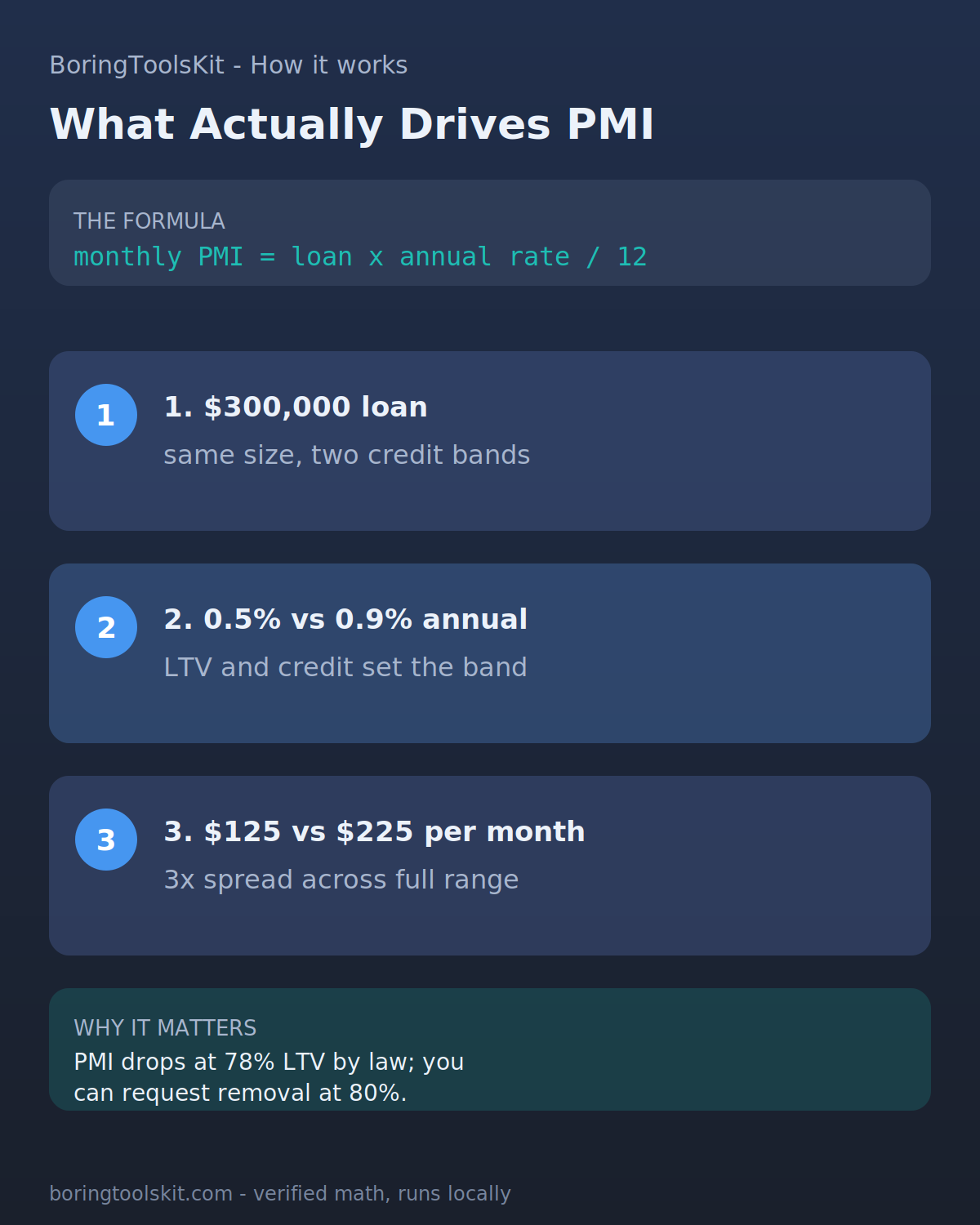
Monthly PMI = loan amount x PMI rate / 12. Conventional PMI typically 0.3%-1.5% annually, driven by LTV and credit; drops off at 78% LTV by law (requested at 80%).
Worked example
$300,000 loan at 0.5% annual PMI costs $125/month; at 0.9% it is $225/month, so the rate quote matters more than the loan size.
FAQ
Is PMI worth it or should I wait for 20% down?
Waiting saves PMI but costs time and rent. A $30,000 down payment saved by waiting 3 years often costs more in rent than 3 years of PMI. Model both scenarios with your real numbers.
When does PMI go away?
It auto-cancels at 78% loan-to-value and you can request cancellation at 80% LTV, per federal rules (FHA MIP is different — it generally stays for the loan life on new loans).
Does PMI protect me if I can't pay?
No — it protects the lender against your default. You can still lose the home to foreclosure. It simply makes a low-down-payment loan possible for you.
Figures are editable example defaults for modeling, not quotes or advice. Financial, tax, and medical outcomes vary with your situation — verify with a qualified professional (CFP, CPA, tax advisor, or veterinarian).