Money market accounts pay higher yields than most savings accounts while staying liquid. This shows what your cash earns at an APY and how it compounds.
Direct answer
What does this tool do?
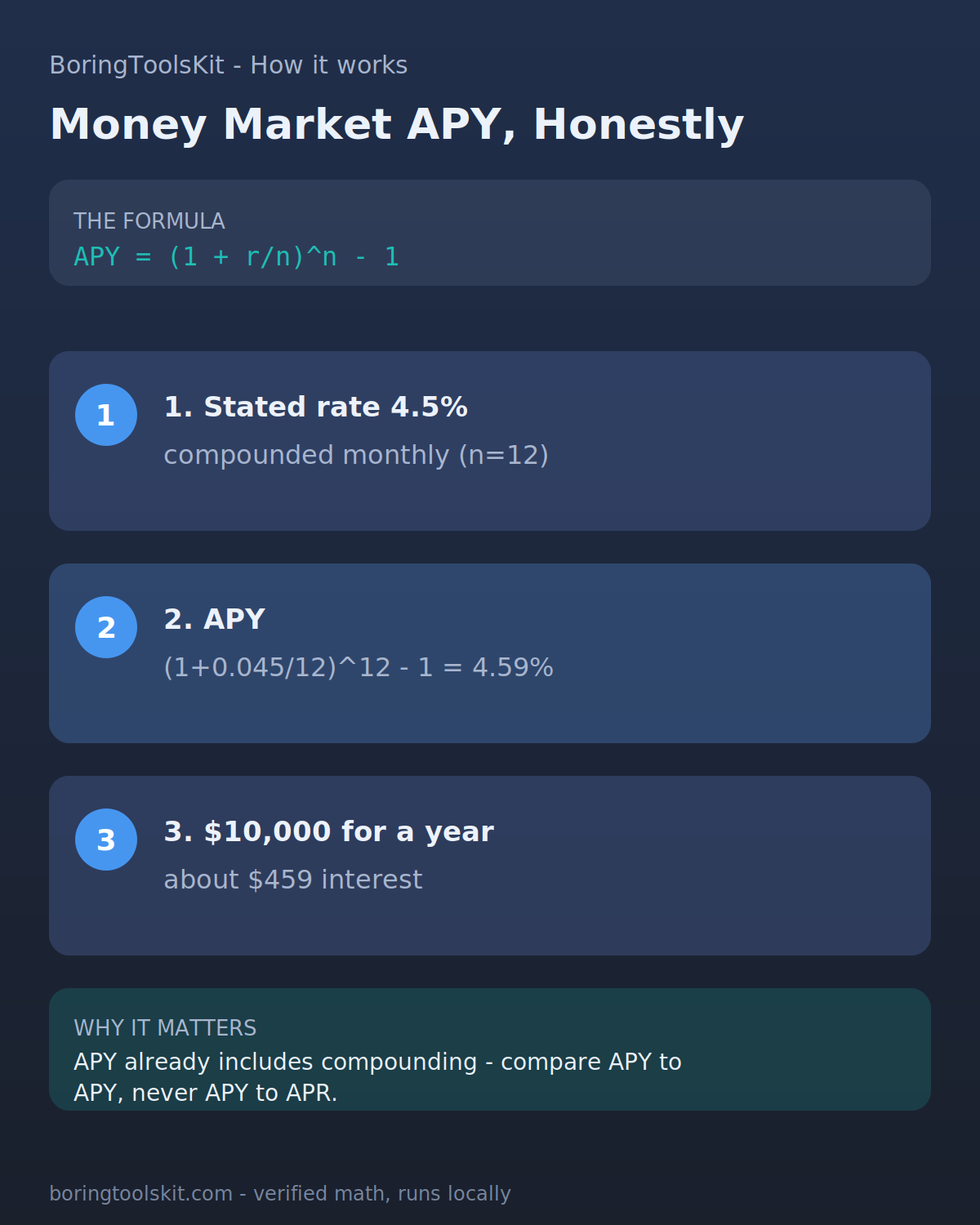
$10,000 in a money market account at 4.5% compounded monthly produces about $37.50 in the first month and roughly $459 over a full year. That 4.5% nominal rate is a 4.59% APY, and the figure assumes no deposits, withdrawals or fees. Enter your own balance and rate in the BoringToolsKit money market calculator to project earnings.
Compounding lifts a 4.5% monthly-compounded rate to a 4.59% APY over a full year. (Source: BoringToolsKit calculation methodology)
On a $10,000 balance, 4.5% compounded monthly earns about $37.50 in the first month. (Source: BoringToolsKit calculation methodology)
APY includes compounding, so compare accounts on APY rather than the stated rate. (Source: Federal Deposit Insurance Corporation)
What it is: a deposit account (often with limited check-writing) that typically pays a higher yield than standard savings, pegged to short-term rates. APY vs APR: APY already includes the effect of compounding — use it for projections. Rates are variable: money market yields track the Fed funds rate and can fall quickly when rates drop. Liquidity: FDIC-insured (at a bank) and liquid, though some accounts cap withdrawals per month.
How this calculator works
APY = (1 + r/n)^n - 1 (r = stated annual rate, n = compounding periods per year). Monthly interest = balance x APY / 12. A 4.5% rate compounded monthly is a 4.59% APY.
Worked example
$10,000 at 4.5% APY compounded monthly earns about $37.50 in the first month and roughly $459 over a full year, assuming no deposits or withdrawals and no fees.
APY includes compounding: compare APY to APY, never APY to APR.
FAQ
Is a money market account safe?
At an FDIC-insured bank, money market accounts are insured up to $250,000 per depositor, like other deposit accounts. Money market FUNDS (mutual funds) are different — not FDIC-insured.
How is a money market account different from a savings account?
Money market accounts usually pay a higher yield and may offer check-writing and a debit card, but they can require a higher minimum balance and cap monthly withdrawals.
Why does the APY matter more than the rate?
APY already accounts for compounding, so it's the true annual return. Two accounts with the same stated rate but different compounding frequencies have different APYs — compare APYs.
Figures are editable example defaults for modeling, not quotes or advice. Financial, tax, and medical outcomes vary with your situation — verify with a qualified professional (CFP, CPA, tax advisor, or veterinarian).
Use this result
Share the current inputs or ask ChatGPT to explain the calculation in context.
Why compounding frequency changes your second year, not your first
Start with $10,000 at a 4.5% stated rate. Monthly compounding pays 0.375% per month ($10,000 x 0.045 / 12 = $37.50). The second month's interest is earned on $10,037.50, so it comes to $37.64, and by month 12 the interest earned in a single month has grown to $38.04. Total for year one: $459.40, which is why the APY is 4.5894% rather than 4.5%.
The frequency penalty is small in year one but permanent. The same 4.5% rate compounded quarterly produces an APY of 4.5765% ($457.65 on $10,000), and daily compounding produces 4.6025% ($460.25). That is a $2.60 spread per $10,000 per year between quarterly and daily compounding. It matters more as the balance grows: on $250,000, the same 0.026 percentage point gap is $65 per year, every year.
Compounding also changes what a rate cut costs you. If the Fed drops rates 15 basis points, an account paying 4.35% compounded daily ($444.57 on $10,000) still beats an account paying 4.45% compounded quarterly ($457.65 minus the cut... it now earns roughly $446.76), so the stated-rate ranking can flip in either direction. Run both accounts through the calculator at APY, not rate, before moving money.
Where the math stops matching the statement
Fees turn a positive APY into a smaller effective yield, and at small balances the fee can exceed the interest. A $5 monthly maintenance fee costs $60 per year. On $10,000 at 4.5894% APY, that leaves $399.40 of $459.40, an effective 3.99% yield. On $1,000, the same account earns $45.94 but pays $60 in fees: a net loss of $14.06 even though the APY headline reads positive. Most money market accounts waive the fee only above a minimum balance, often $2,500 to $10,000, so check the waiver threshold before the APY.
Promotional tiers complicate the headline rate. Banks frequently pay one APY on the first $25,000 and a lower one above it. On $40,000 at 4.5% APY on the first $25,000 and 1.5% on the remainder, the blended return is $1,125 plus $225, or 3.375% blended APY, not 4.5%. Enter tiered balances separately.
Rates are variable, not locked. An account quoted at 4.5894% APY today can be repriced any business day; the figure in this calculator is a projection of current terms, not a contract. Withdrawal caps are the other practical limit: under Regulation D, convenient transfers were capped at six per month (the federal cap was suspended in 2020, but many banks keep their own limits), and exceeding them can trigger a fee or account conversion. Finally, the model assumes no mid-month deposits. Depositing on day 20 forfeits most of that month's interest under monthly compounding; daily-compounding accounts credit partial months, which is worth up to about $11 per $10,000 per year at these rates.