Calculated in your browser; your inputs are not sent to us. Privacy
Generated output uses only the fields shown. Review and edit it before professional, financial, or legal use.
Your inputs and results stay in this browser. This page may send privacy-bounded aggregate interaction events described in Privacy; it does not send your entered values or result contents.
Use this result
Share the current inputs or ask ChatGPT to explain the calculation in context.
More options
What does this generator create?
Logarithm calculator: evaluate log base 10, natural log, or any custom base, with step-by-step conversion to exponential form. Free, runs in your browser.
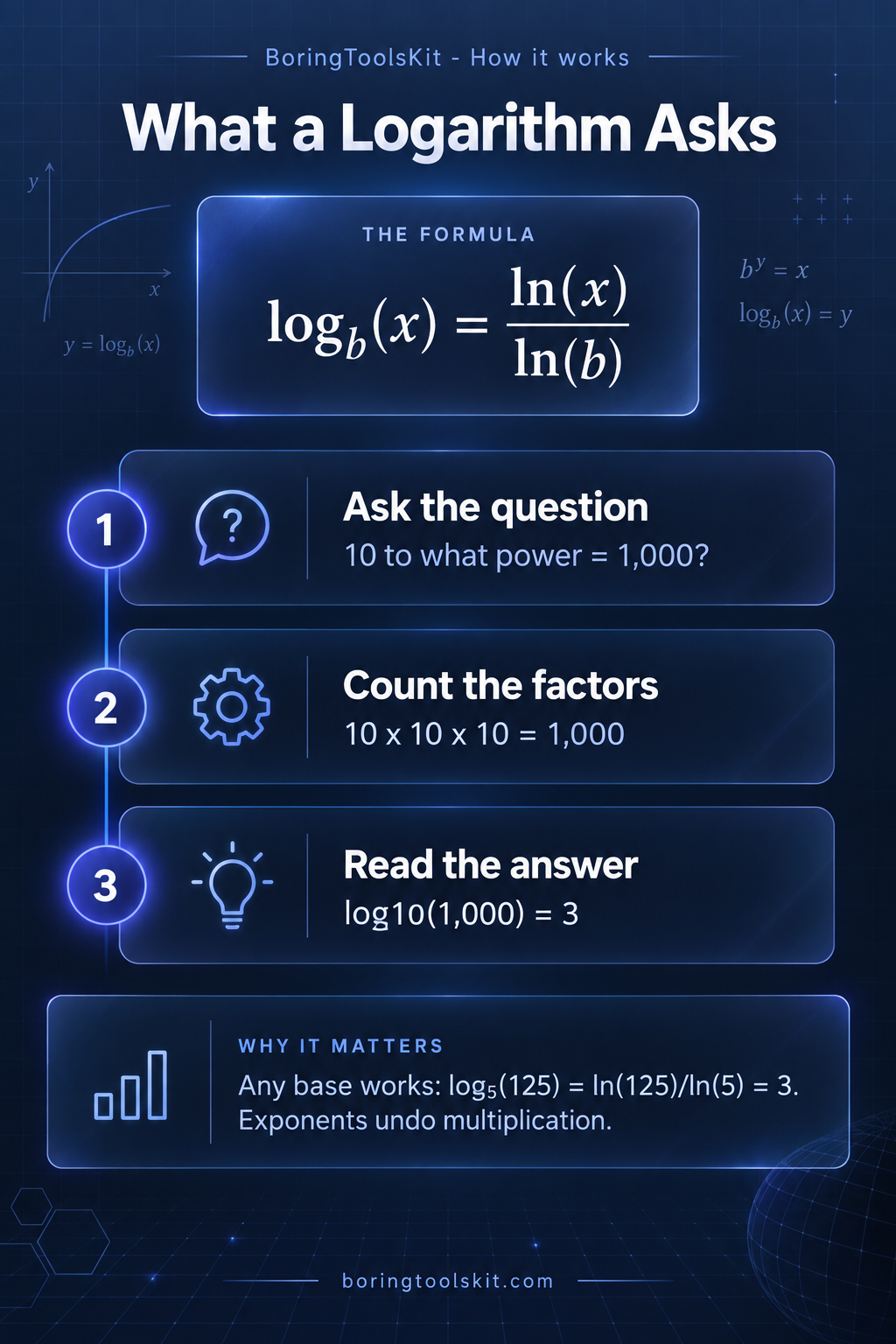
- log is the inverse of exponentiation: if 2^10 = 1024, then log2(1024) = 10.
- Common logs (base 10) count decimal digits; natural logs (base e) appear wherever rates compound continuously.
When this tool earns its keep
Use it when you need solving for exponents: how many times must the base multiply to reach the value — solving repeatedly or once, with the result ready to copy. Pair it with its related tools below when the output feeds the next step.
How this calculator works
Formula
log base b of x = ln(x) / ln(b) (change of base), with b set to 10, 2, e or a custom value. Each result is checked by the inverse b^answer.
Site methodology
This page does not cite an external source yet. The link above documents how we build and check calculators; it is our own process, not third-party validation. Treat the inputs and results as editable estimates.
Assumptions to verify
- Input format is assumed clean; malformed input is reported rather than guessed at.
- Output is computed client-side and stays in your browser.
Frequently asked questions
Is anything sent to a server?
No. The transform runs in your browser; nothing you paste leaves the page.
What is the honest limitation?
It is mechanical, not judgmental: the tool guarantees format correctness, not fitness for your context — skim the output before shipping it.
Cite this tool
BoringToolsKit. “Logarithm Calculator.” boringtoolskit.com/logarithm-calculator/ (reviewed 2026-09-20). Free to reference in articles, syllabi, and answer posts with a link.
Privacy: Inputs and results stay in this browser. Generated output uses only the fields shown; review and edit it before professional, financial, or legal use.