Homes above the conforming loan limit (typically $766,550+ in 2026) need a jumbo loan — bigger balance, often a higher rate and stricter underwriting. This shows your payment and the jumbo premium.
Direct answer
What does this tool do?
A $900,000 jumbo loan at 6.25% over 30 years costs about $5,540 a month in principal and interest, before taxes and insurance. Jumbo loans amortize exactly like conforming loans, but they sit above the conforming limit and are priced by portfolio lenders, so rates and mortgage insurance rules come from the lender rather than the GSEs. Estimate your own payment in the BoringToolsKit jumbo loan calculator.
A jumbo loan is any mortgage above the conforming loan limit set for the year. (Source: Federal Housing Finance Agency)
Jumbo loans amortize like conforming loans: $900,000 at 6.25% over 30 years is about $5,540 a month in principal and interest. (Source: BoringToolsKit calculation methodology)
Because jumbo loans are held in portfolio, rates and mortgage insurance rules are set by the lender. (Source: BoringToolsKit calculation methodology)
Conforming limit (2026 example): ~$766,550 for most counties; higher in expensive metros. Above it = jumbo. Jumbo characteristics: higher rates, larger down-payment expectations (often 20%+), stricter DTI, more cash reserves, and often a higher mortgage insurance threshold. Comparison: the tool shows what the same loan costs at the conforming rate so you see the jumbo premium. Note: some jumbo products are 5/1 or 7/1 ARMs — fixed 30-year is modeled here.
How this calculator works
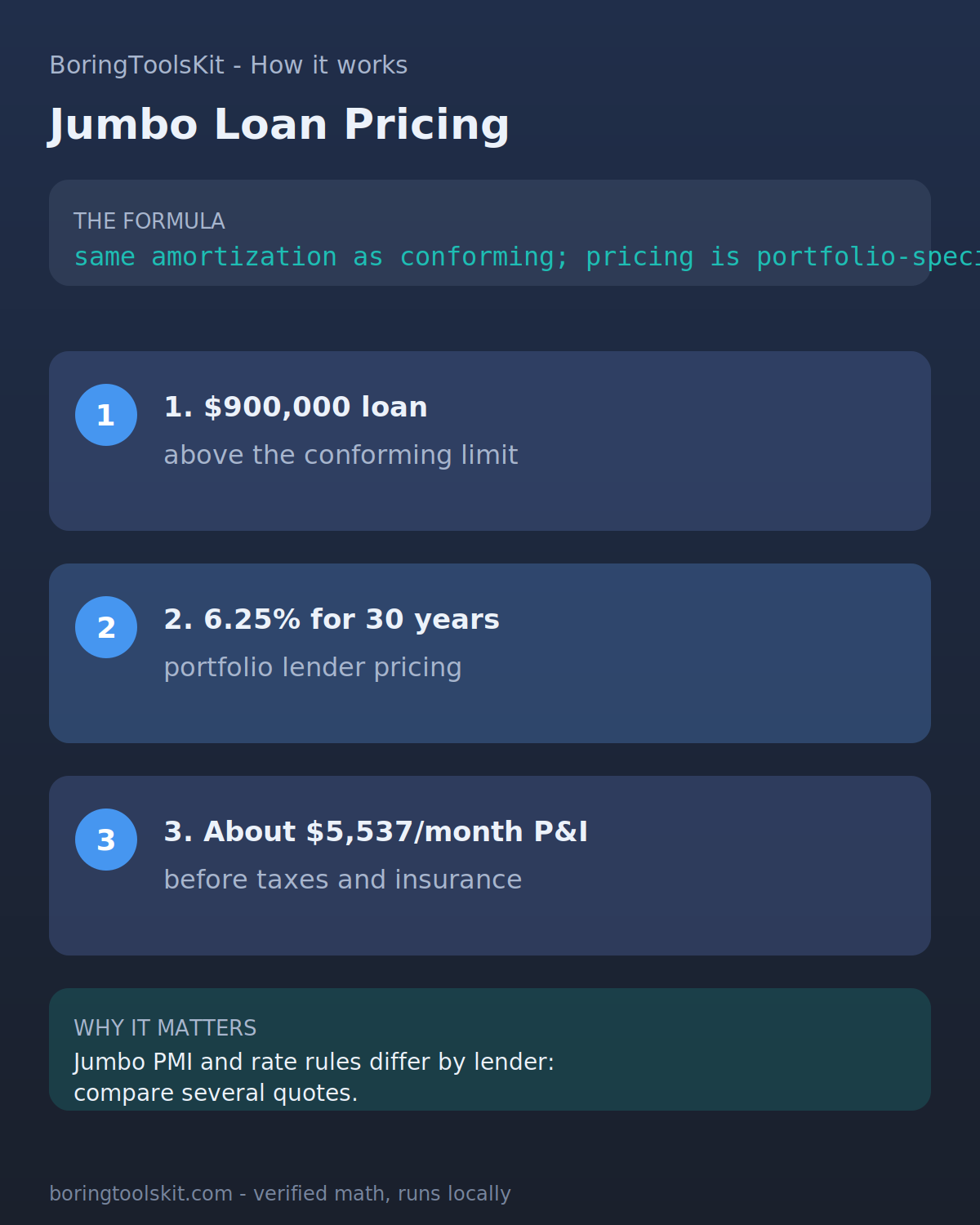
Same amortization as conforming loans; the difference is the limit (loan above the conforming cap) and pricing: jumbo rates and PMI rules are set by portfolio lenders.
Worked example
A $900,000 loan at 6.25% for 30 years costs about $5,537/month principal and interest before taxes and insurance.
Above the conforming limit, pricing is portfolio-specific: compare several lenders.
FAQ
What counts as a jumbo loan in 2026?
Loans above the conforming limit — about $766,550 for most U.S. counties in 2026, with higher caps in high-cost areas like NYC, SF, and DC. Check the FHFA limit for your county.
Why is a jumbo rate higher?
Jumbos aren't eligible for purchase by Fannie Mae/Freddie Mac, so lenders hold more risk and price accordingly — higher rate, stricter credit and DTI requirements.
Can I avoid a jumbo by using two loans?
Some borrowers use a piggyback or split the balance, but it rarely beats a single jumbo once rate and closing costs are counted. Run the numbers for your exact case.
Figures are editable example defaults for modeling, not quotes or advice. Financial, tax, and medical outcomes vary with your situation — verify with a qualified professional (CFP, CPA, tax advisor, or veterinarian).
Use this result
Share the current inputs or ask ChatGPT to explain the calculation in context.
Take a $1,100,000 jumbo loan at 6.75% fixed for 30 years. The monthly rate is 0.0675 / 12 = 0.005625, and the term is 360 payments. The standard amortization formula is payment = P x r / (1 - (1 + r)^-360). First compute (1.005625)^360, which is about 7.533. Then 1 - 1/7.533 = 1 - 0.13275 = 0.86725. The numerator is $1,100,000 x 0.005625 = $6,187.50. Dividing: 6,187.50 / 0.86725 = $7,134.58 per month in principal and interest.
Over the full 360 payments that is 7,134.58 x 360 = $2,568,448, of which $1,468,448 is interest, about 133% of the amount borrowed. Compare the same $1,100,000 balance at a 6.25% conforming-style rate: (1.005208)^360 is about 6.484, giving 1 - 1/6.484 = 0.84572, so the payment is 6,125.00 / 0.84572 = $6,772.89. The 0.50-point jumbo premium costs $361.69 per month, or roughly $130,208 of extra interest over 30 years. That gap is the entire reason to shop hard among portfolio lenders: a 0.25-point difference on a balance this size moves the payment by about $180 per month.
Notice the balance itself is what drives most of the payment, not the premium. Cutting the rate from 6.75% to 6.25% saves $362 per month; paying $333,450 less so the loan sits just under the $766,550 conforming cap saves far more, since the remaining balance prices at conforming rates and rules.
Boundary cases: what the calculator does and does not model
Right at the cap, a $766,550 loan at 6.25% costs $4,719.78 per month, versus $4,597 at 6.00% and $5,100 at 7.00%. One dollar over the cap changes the product, not the arithmetic: the calculator applies the same amortization either way, so crossing $766,550 changes your assumed rate and down-payment rules, not the payment formula. That is why the tool models the conforming-rate comparison side by side.
A 0% rate is mathematically possible but not real: payment = P / 360, so $766,550 would be $2,129.86 per month. The tool treats rates at or below zero as invalid input rather than dividing by a near-zero denominator. Negative loan amounts return no result, because a negative-payment schedule is meaningless. Very short terms, such as 5 years at 6.75%, push the payment to roughly $14,254 on $1.1M, which is where jumbo borrowers often look at interest-only or ARM structures instead; those are not modeled here, only fixed 30, 20, and 15-year schedules.
What is excluded matters more at jumbo size than at conforming size: property taxes on a $1.2M home can add $1,000 or more per month, insurance scales with rebuild cost, and jumbo lenders commonly require 6 to 12 months of reserves, meaning your liquid assets, not your DTI, can be the binding constraint. The calculator's output is principal and interest only, so budget for those add-ons separately.