Irrigation Water Usage Calculator
How many gallons does a watering actually use? This multiplies your irrigated area by the water depth you apply, then projects weekly and seasonal totals for budgeting and cost.
What does this tool do?
Irrigation Water Usage Calculator computes the result directly in your browser — How many gallons does a watering actually use? This multiplies your irrigated area by the water depth you apply, then projects weekly and seasonal totals for budgeting and cost. Nothing you enter is uploaded or stored.
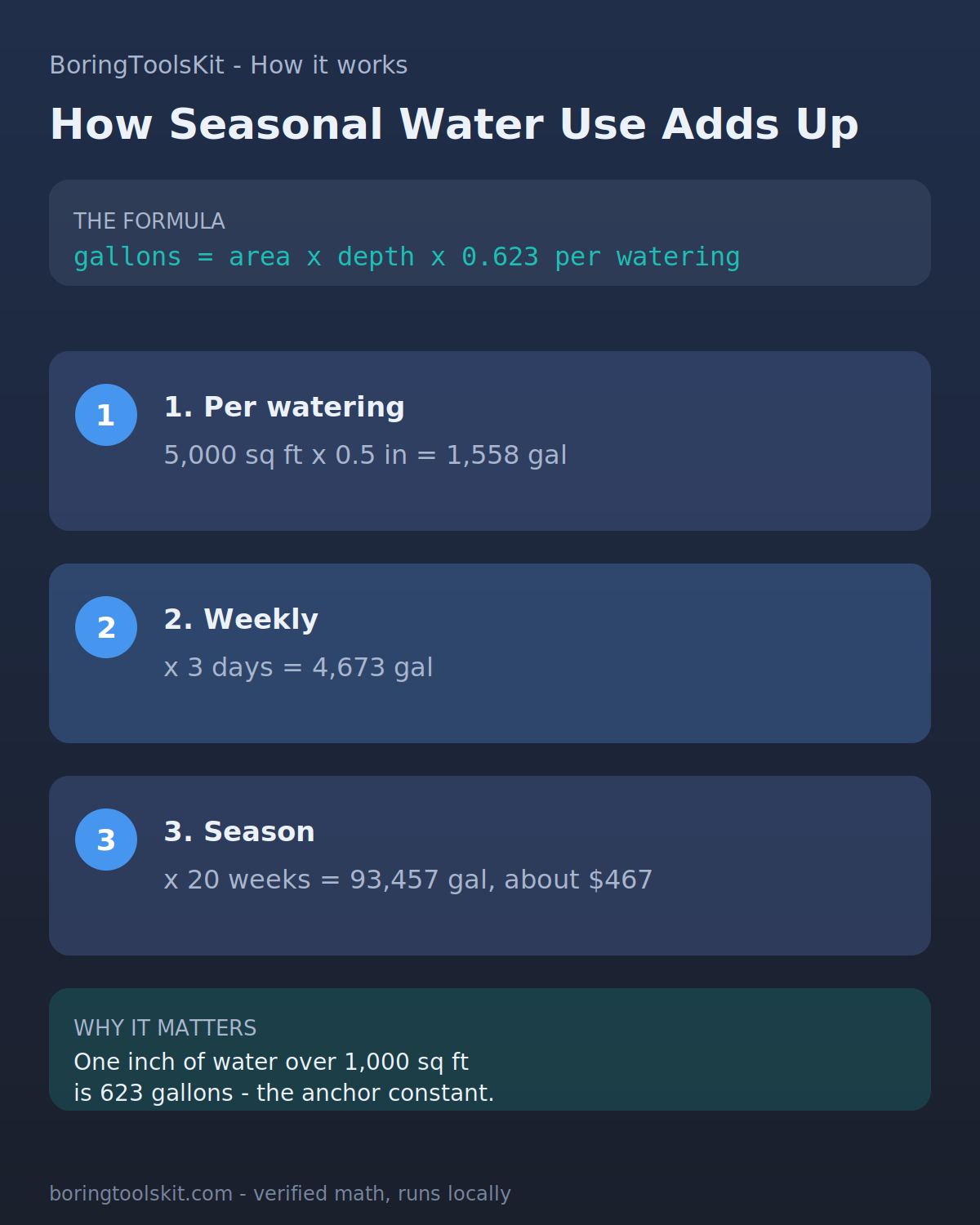
Formula: gallons per watering = area (sq ft) × depth (in) × 0.623. Weekly = per-watering × days; monthly ≈ weekly × 4.33; seasonal = weekly × weeks; cost = seasonal gallons ÷ 1,000 × $/1,000 gal. Use: budget irrigation before the season, compare watering schedules, and size rain-barrel or well capacity.
How this calculator works
Formula: gallons per watering = area (sq ft) × depth (in) × 0.623. Weekly = per-watering × days; monthly ≈ weekly × 4.33; seasonal = weekly × weeks; cost = seasonal gallons ÷ 1,000 × $/1,000 gal. Use: budget irrigation before the season, compare watering schedules, and size rain-barrel or well capacity.
Worked example
A 5,000 sq ft yard watered 0.5 inches, 3 days a week, 20 weeks: each watering uses 1,558 gallons, weekly 4,672, seasonal 93,450 gallons, about $467 at $5.00 per 1,000 gallons.
What Actually Drives Your Gallon Total
The per-watering result comes straight from area times depth times 0.623, the gallon equivalent of one inch over one square foot. Doubling either input doubles the gallons: 1 inch over 1,000 sq ft is about 623 gallons, while a half-inch watering is about 311. Watering days per week then multiplies the per-watering total, so frequency changes weekly volume as directly as depth does.
The projections build in fixed steps: weekly gallons equal per-watering times days, monthly gallons are weekly times 4.33, and seasonal gallons are weekly times the season length in weeks. Cost divides seasonal gallons by 1,000 and multiplies by your rate. For scale, 1 inch weekly across 5,000 sq ft is about 3,115 gallons, and 100,000 seasonal gallons at $5 per 1,000 gallons costs $500.
Adjusting Inputs to Trim Water and Cost
Use the calculator to compare schedules before you commit. Try the same depth at two, three, or four days per week and watch weekly gallons climb; water deeply and less often to encourage deep roots instead of frequent light soakings. Subtract recent rainfall from your target depth, and check that the depth matches actual output, since misaligned heads and leaks add gallons you never planned for.
The weekly total also tells you how much capacity to have on hand, which is how you size rain barrels or a well draw. Monthly gallons, roughly weekly times 4.33, make an easy budget line to track against your bill. Use drip for beds and mulch to cut evaporation, then rerun the numbers with the lower depth and shorter season to see the savings.
FAQ
How many gallons to water 1,000 sq ft?
1 inch over 1,000 sq ft is about 623 gallons. A half-inch watering is about 311 gallons; a 1-inch weekly watering across 5,000 sq ft is about 3,115 gallons.
How do I reduce irrigation water use?
Subtract rainfall from your target depth, water deeply and less often to encourage deep roots, fix leaks and misaligned heads, use drip for beds, and mulch to cut evaporation.
What is the water cost formula?
Multiply your seasonal gallons by your water rate (typically $ per 1,000 or 100 cu ft). Example: 100,000 gal at $5/1,000 gal is $500 for the season.
Figures are editable example defaults for planning, not guarantees. Water needs vary by crop, soil, weather, season, and local climate — check ET data (NOAA, your state CIMIS/AgriMet network) and verify with your local extension service or agronomist.