Interior Painting Cost Calculator
Interior painting is one of the cheapest ways to transform a home, but quotes vary widely by prep and paint quality. This estimates your range by wall area and finish tier.
What does this tool do?
Interior Painting Cost Calculator computes the result directly in your browser — Interior painting is one of the cheapest ways to transform a home, but quotes vary widely by prep and paint quality. This estimates your range by wall area and finish tier. Nothing you enter is uploaded or stored.
What moves cost most: wall condition (prep), ceiling height, paint brand, and trim detail. Labor share: 70-80% — painting is a labor trade. Regional: 0.85× rural to 1.35× metro. Note: the material-quantity paint calculator estimates how much paint you need; this one estimates what the job costs.
How this calculator works
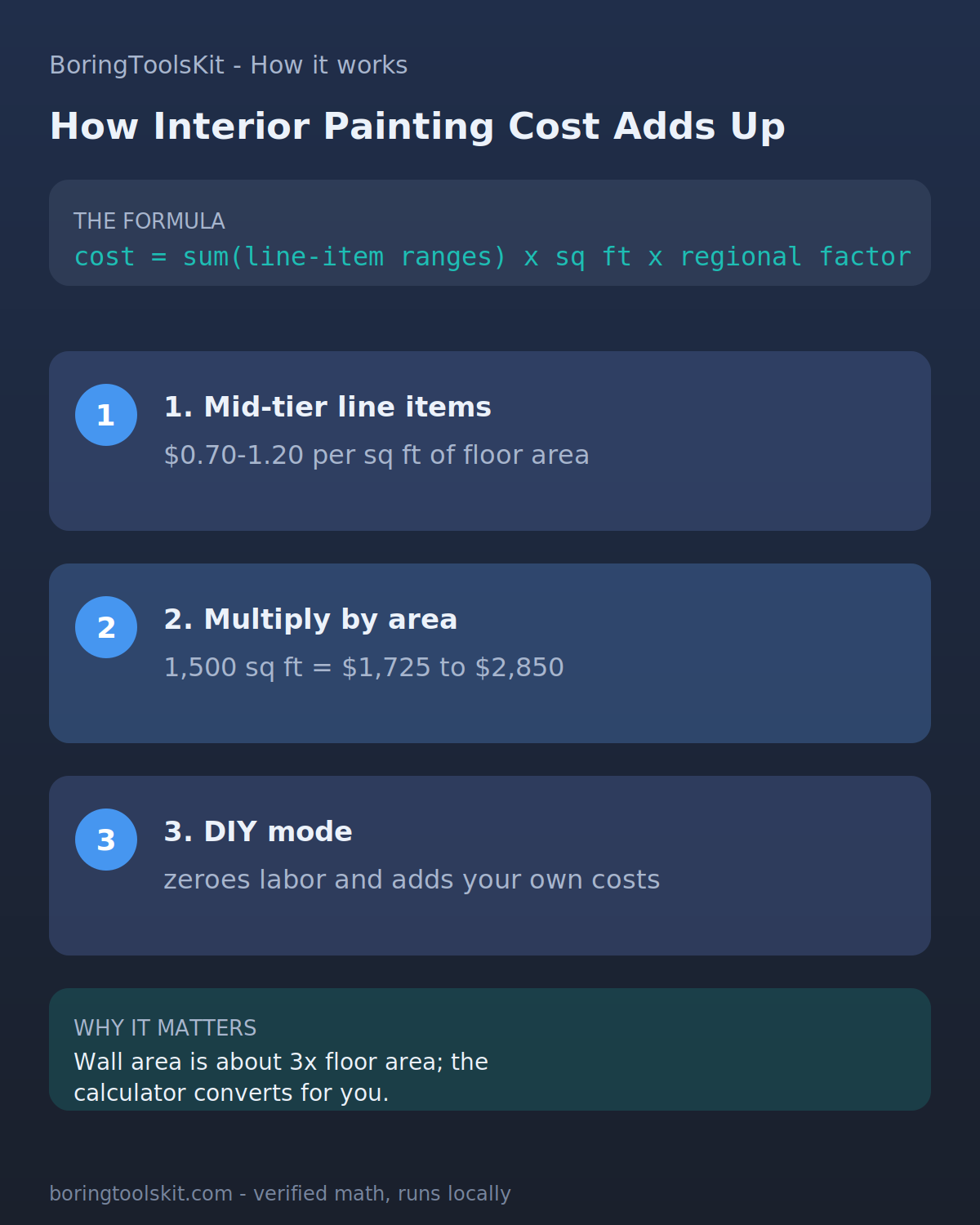
cost = sum(line-item ranges per sq ft) x size x regional factor. Mid-tier items: Paint (mid-grade) $0.35-0.55, Labor (brush + roll) $0.6-0.95, Prep (patching + sand) $0.2-0.4.
Worked example
A 1500 sq ft project at mid tier with the national labor factor (1.0): line items sum to $1,725-$2,850, midpoint about $2,288. Try these numbers in the calculator above; adjust the regional multiplier for your metro.
What drives interior painting cost most
Per square foot of wall, mid-grade paint runs $0.35 to $0.55, brush-and-roll labor runs $0.60 to $0.95, and prep work such as patching and sanding adds $0.20 to $0.40. Across 2026 examples, professional interior painting lands around $1 to $3 per square foot of wall area, with labor accounting for 70 to 80 percent of the total.
Wall condition is the biggest price driver. Smooth walls that only need paint sit near the low end, while surfaces requiring patching, sanding, and priming cost far more per square foot. For scale, a typical 1,500 square feet of wall runs about $2,000 to $4,000 with a pro, so the gap between a light refresh and a heavy-prep job is real money.
How to keep your interior painting budget honest
Measure your wall area carefully before entering it, since the square footage input drives every line in the estimate. Then check the regional labor multiplier, which ranges from 0.85 to 1.35. Because labor is the largest single cost at 70 to 80 percent of the total, a high-cost region can push the same room's quote well above a low-cost one.
Choose your finish tier honestly rather than aspirationally; stepping up a tier raises paint cost on every square foot you enter. If you toggle DIY mode, remember you keep the labor savings of 70 to 80 percent but still buy paint, and the finish quality risk is on you. Compare both numbers before deciding who holds the roller.
FAQ
How much does it cost to paint a house interior?
Roughly $1-$3 per square foot of wall area for professional interior painting in 2026 examples. A typical 1,500 sq ft of wall runs about $2,000-$4,000.
Can I save money by doing it myself?
DIY saves the labor cost (70-80% of the total), but you buy paint and lose the finish quality. For a clean result on large areas, a pro is usually worth it.
What affects interior painting price most?
Wall condition and prep are the biggest driver. Walls that need patching, sanding, and priming cost far more per square foot than smooth walls that just need paint.
These are editable example ranges for budgeting, not contractor bids. Actual project cost varies by region, site condition, and finish level. Get 3 quotes before committing.