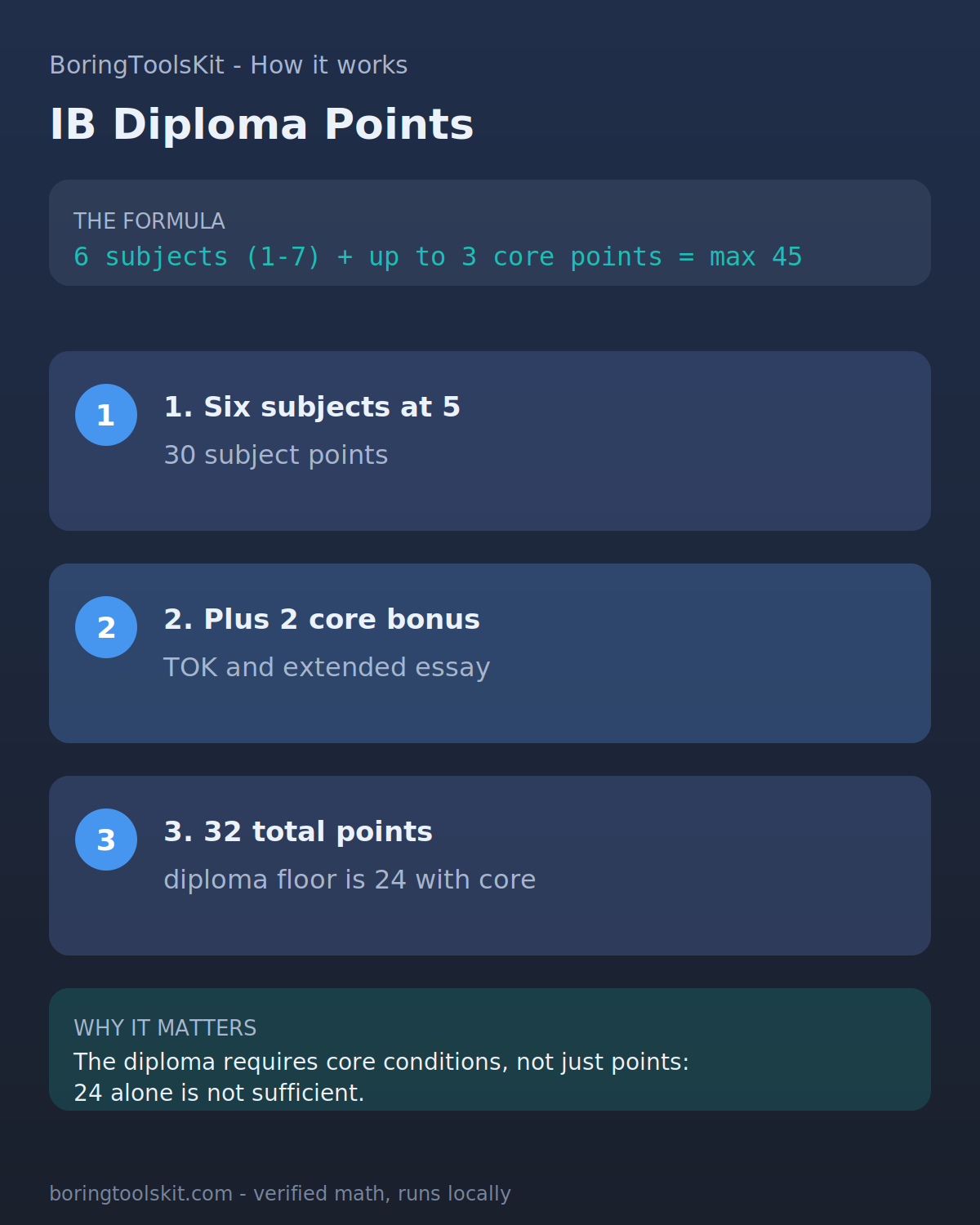
The IB Diploma is scored on a 45-point scale across six subjects plus core points. This sums your predicted or actual grades into a total score.
Direct answer
What does this tool do?
IB Grade Calculator computes the result directly in your browser — The IB Diploma is scored on a 45-point scale across six subjects plus core points. This sums your predicted or actual grades into a total score. Nothing you enter is uploaded or stored.
IB scoring: six subjects each graded 1-7 (max 42), plus up to 3 bonus points from the Theory of Knowledge essay and Extended Essay combined (max 45). Pass: at least 24 total, with no subject below 3, at least 12 points across the higher-level subjects, and completion of core requirements. Grades: 1-7, where 4 is generally a pass on an individual subject and 7 is excellent. Note: official grade boundaries move by session and subject — treat this as a scoring tool, not a guarantee.
How this calculator works
IB diploma scoring: each of 6 subjects graded 1-7 (max 42) plus up to 3 bonus points from TOK and the extended essay; 24 minimum with core requirements to earn the diploma.
Worked example
Six subjects at 5s = 30 points, plus 2 core bonus points = 32 total, comfortably above the 24-point diploma floor.
42 subject points plus 3 core points = 45 maximum; 24 with core conditions earns the diploma.
FAQ
What is a good IB score?
24 is the pass threshold for the Diploma. 30+ is solid, 36+ is strong (competitive for many selective universities), and 40+ is exceptional.
How many points can you get on the IB Diploma?
45 maximum: 42 from six subjects (7 each) plus 3 bonus points from TOK and the Extended Essay combined.
What is the passing score for IB?
24 points is the minimum for the full Diploma, with conditions (no subject below 3, sufficient higher-level points). Courses can be taken as certificates without the full Diploma.
Figures are editable example defaults for modeling, not quotes or advice. Financial, tax, and medical outcomes vary with your situation — verify with a qualified professional (CFP, CPA, tax advisor, or veterinarian).
Use this result
Share the current inputs or ask ChatGPT to explain the calculation in context.
How the TOK and Extended Essay matrix converts to bonus points
The 3 core points come from a combined matrix. TOK and the Extended Essay are each graded A to E, and the pair is looked up in the matrix: AA gives 3, BA and AB give 2, BB, CA and AC give 1, and any D or E combination gives 0 to 1. The worst case is an E in either component, which caps the award at 0 and can block the diploma outright.
Example: a student scores B in TOK and C in the Extended Essay. Reading the matrix at row B, column C gives 1 bonus point. If those six subjects earned 5, 6, 4, 5, 5, and 6, that is 31 subject points, so the total is 31 + 1 = 32. The calculator applies this same lookup: enter each subject grade 1 to 7, pick the TOK and EE letters, and it sums subject points plus the matrix result against the 24-point floor.
One matrix quirk worth checking by hand: a student with five 7s (35 subject points) and D in both TOK and EE gets only 0 bonus points, so 35 total, while a student with 30 subject points and A in both gets 33. The core can move the total by 3 either way, which matters near a 36-point university cutoff.
Where the 24-point floor is not the whole story
The 24 minimum has conditions the raw total can hide. A student could score 3, 3, 3, 5, 5, 5 = 24 and still fail, because the diploma requires no grade of 1, no more than one grade of 2, and no more than three grades of 3 across all subjects. There is also the higher-level rule: at least 12 combined points across the three HL subjects, with no HL grade below 3. Standard level needs at least 9 combined across the three SL subjects.
Try the edge case: 4, 4, 4 at HL (12 combined, passes) and 2, 3, 4 at SL (9 combined, exactly passes) plus a 2 bonus = 24 total and the diploma stands, but drop one HL grade from 4 to 3 and the HL total falls to 11, failing on 24 points exactly. Roughly 79 to 81 percent of candidates earn the diploma in a typical session, and the global mean diploma score sits around 29 to 30 points, so scores of 33 and above put a candidate well above the middle of the distribution. Retake rules allow re-sitting up to three sessions to replace individual subject grades.