High-Tensile Fence Materials Calculator
High-tensile wire is pulled taut between strong corner braces, covering ground fast with fewer posts. It is often the cheapest option on long, straight runs.
What does this tool do?
High-Tensile Fence Materials Calculator computes the result directly in your browser — High-tensile wire is pulled taut between strong corner braces, covering ground fast with fewer posts. It is often the cheapest option on long, straight runs. Nothing you enter is uploaded or stored.
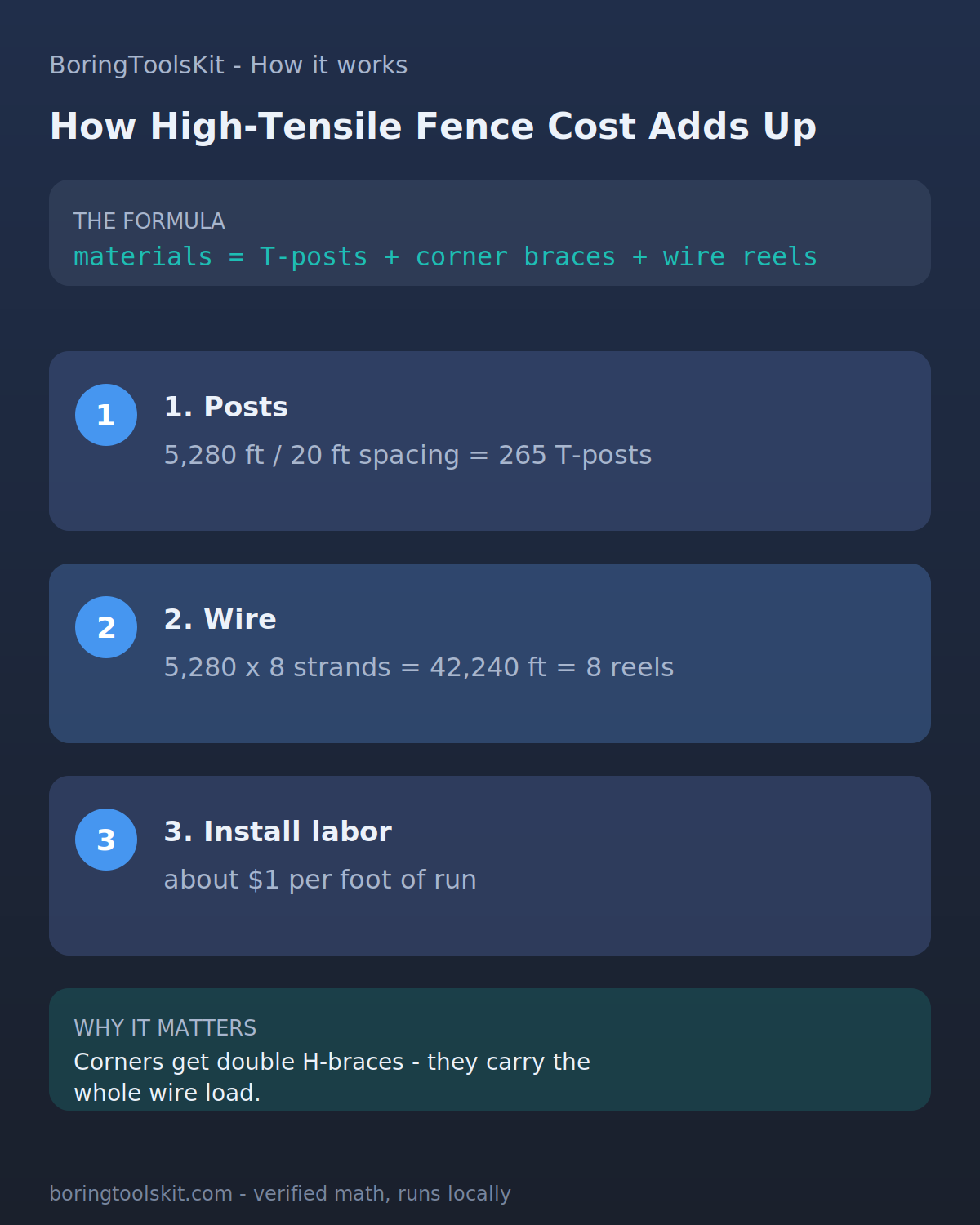
Formula: posts = run ÷ spacing (15-25 ft); wire = run × strands; materials = posts + wire reels; installed = materials + run × $1.10/ft labor. Cost figures are 2026 example midpoints (FenceCalc: high-tensile smooth $0.50-$1.25 mat / $1.50-$3.50 installed per ft). Use: high-tensile is cheapest on long, straight, well-braced runs; it can be electrified for added effectiveness but needs rigorous corner construction and yearly tension checks.
How this calculator works
Formula: posts = run ÷ spacing (15-25 ft); wire = run × strands; materials = posts + wire reels; installed = materials + run × $1.10/ft labor. Cost figures are 2026 example midpoints (FenceCalc: high-tensile smooth $0.50-$1.25 mat / $1.50-$3.50 installed per ft). Use: high-tensile is cheapest on long, straight, well-braced runs; it can be electrified for added effectiveness but needs rigorous cor
Worked example
One mile (5,280 ft), 8 strands, posts every 20 ft, 4 corners: 265 T-posts, 8 double-braced corner posts, 42,240 ft of wire = 8 reel(s); materials near $3,261 plus about $1/ft installed labor.
What Drives Your High-Tensile Fence Estimate
Run length scales every line item at once. The calculator divides your run by post spacing, so a 1,000-foot fence needs about 67 line posts at 15-foot spacing but only 40 at 25 feet. Wire footage multiplies length by strand count, meaning each additional strand adds a full pass of wire down the fence line. Longer runs spread corner hardware over more distance, which is where high-tensile builds its cost advantage.
Corner count and labor assumptions fill out the rest. Every corner requires a double H-brace, so each direction change adds a heavy assembly that a straight run avoids. Labor adds a flat $1.10 per foot across the whole run, while materials for smooth high-tensile land between $0.50 and $1.25 per foot in 2026 examples. Installed totals of $1.50 to $3.50 per foot bracket the range, with strand count pushing you toward either end.
Getting the Inputs Right Before You Build
Set post spacing at the wide end of the 15 to 25 foot range on long, straight runs, and move toward 15 feet where terrain rolls or the line bends. Use 6 to 8 strands for typical smooth-wire fence, or drop to 4 to 5 if you plan barbed. Count every direction change as a corner, even gentle bends, because each one needs its own double H-brace to hold tension.
Run the calculator at two or three spacings before you buy. Moving from 15-foot to 25-foot spacing trims the line post count by roughly 40 percent, and that difference compounds on long runs. Price a smooth configuration against barbed too: barbed needs only 4 to 5 strands, but its tighter 12 to 16 foot post spacing erases part of the savings. After installation, schedule yearly tension checks, and consider electrifying smooth wire for added effectiveness.
FAQ
Is high-tensile fence cheaper than barbed?
Often yes on long straight runs. It uses fewer posts (15-25 ft spacing vs 12-16) and less total material, but requires much stronger corner assemblies. In 2026 examples it runs $1.50-$3.50/ft installed.
Why do high-tensile fences need double braces?
High-tensile wire is pulled to thousands of pounds of tension. Without a double H-brace minimum at every corner, the tension pulls posts out of alignment and the fence sags.
Can high-tensile fence be electrified?
Yes. Smooth high-tensile wire can be electrified for added effectiveness, and permanent electric subdivisions often use it. Springs and tensioners handle thermal expansion and contraction.
Figures are editable example defaults for planning, not guarantees. Fence material, labor, and installation costs vary by region, terrain, and year — verify with local suppliers, your NRCS office for EQIP cost-share, and a fencing contractor before committing to a project.