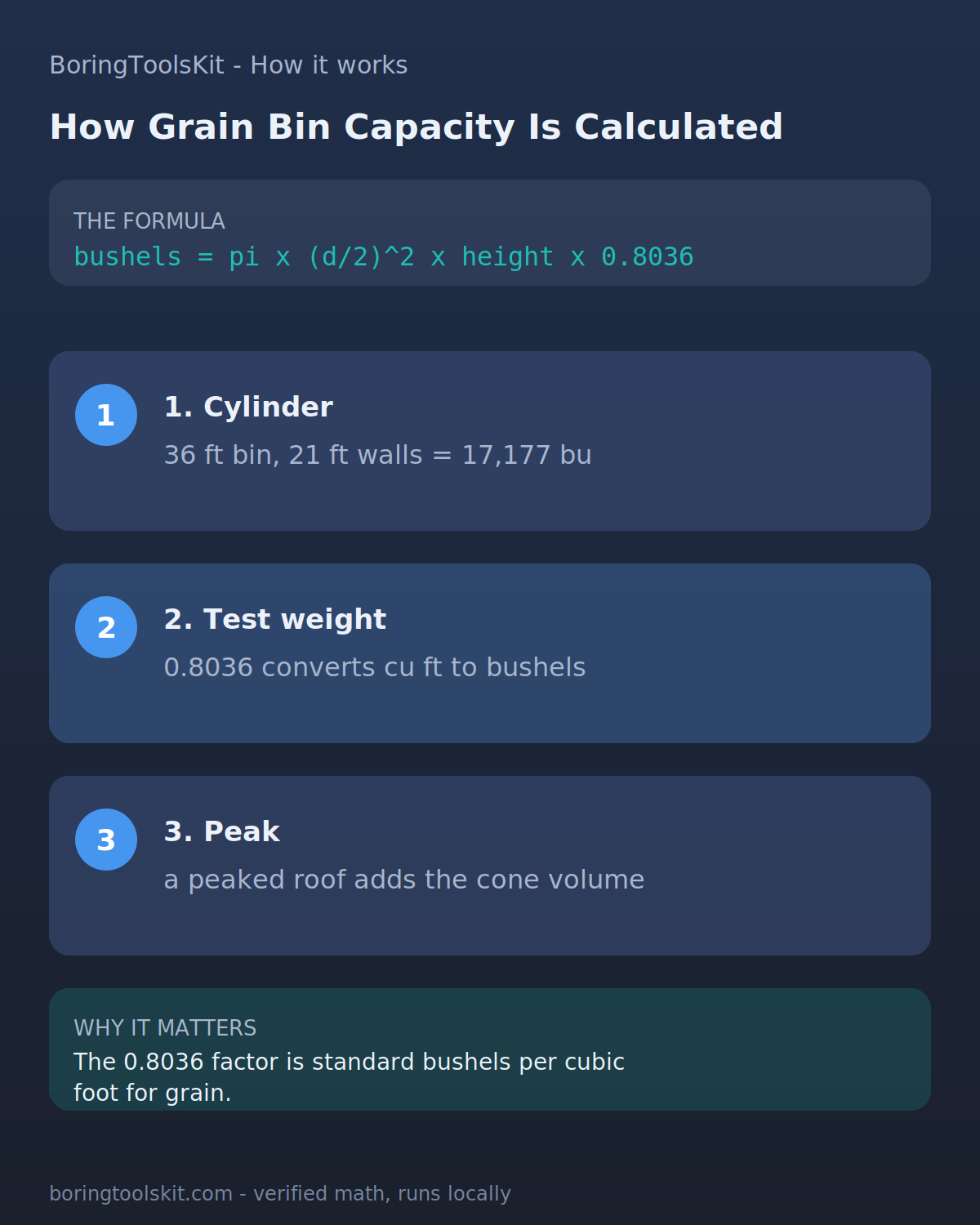
Wondering if your bin will hold the harvest? This converts bin dimensions to bushel capacity using the standard 0.8036 bushels per cubic foot, including the peaked roof fill.
Direct answer
What does this tool do?
Grain Bin Capacity Calculator computes the result directly in your browser — Wondering if your bin will hold the harvest? This converts bin dimensions to bushel capacity using the standard 0.8036 bushels per cubic foot, including the peaked roof fill. Nothing you enter is uploaded or stored.
Formula: cylinder capacity = π × (diameter ÷ 2)² × eave height × 0.8036 bushels/cu ft. A peaked roof that fills to the cone adds about 15-20% (modeled as a cone at ~20% of diameter height). Usable capacity: actual bushels differ by grain test weight (corn 56 lb/bu, soybeans 60, wheat 60) and how completely the bin fills. Check the sticker: manufacturers publish rated capacity charts — use this as a planning estimate and confirm against your bin's nameplate.
How this calculator works
Formula: cylinder capacity = π × (diameter ÷ 2)² × eave height × 0.8036 bushels/cu ft. A peaked roof that fills to the cone adds about 15-20% (modeled as a cone at ~20% of diameter height). Usable capacity: actual bushels differ by grain test weight (corn 56 lb/bu, soybeans 60, wheat 60) and how completely the bin fills. Check the sticker: manufacturers publish rated capacity charts — use this as
Worked example
A 36-ft bin with 21-ft eave walls: cylinder capacity is about 17,177 bushels (pi x 18^2 x 21 x 0.8036). A peaked roof adds roughly 1,963 bushels (cone height 20% of diameter).
Step-by-step: how this grain bin capacity calculation builds its result
FAQ
How many bushels does a 36x21 grain bin hold?
About 17,200 bushels filled to the eave, or roughly 20,000+ with a peaked roof, using 0.8036 bu/cu ft. Check the manufacturer's chart for your exact bin.
How many cubic feet are in a bushel?
One US bushel equals 1.2445 cubic feet, so there are 0.8036 bushels per cubic foot. Multiply bin volume in cubic feet by 0.8036.
Does grain type change bin capacity?
The volume in bushels is the same; what changes is weight (test weight). A bin holds the same number of bushels of corn or soybeans, but a bushel of corn weighs 56 lb and soybeans 60 lb.
Figures are editable example defaults for planning, not guarantees. Crop inputs, prices, and moisture handling vary by farm, region, and year — verify with your local extension service and agronomist.
Use this result
Share the current inputs or ask ChatGPT to explain the calculation in context.
Second worked example: a 30-ft bin with 18-ft walls
Take a 30-ft diameter bin with 18-ft eave walls, filled level to the eave. The cylinder volume is pi x 15^2 x 18 = 12,723.45 cubic feet. Multiplying by 0.8036 bushels per cubic foot gives 12,723.45 x 0.8036 = 10,224.6 bushels, call it 10,225.
Now let the peaked roof fill as a cone with height equal to 20 percent of the diameter: 0.20 x 30 = 6 ft. Cone volume is (1/3) x pi x 15^2 x 6 = 1,413.7 cubic feet, which converts to 1,413.7 x 0.8036 = 1,136.1 bushels. That cone is 11.1 percent of the cylinder total, which is why smaller bins gain less in percentage terms than tall narrow ones with the same roof rule.
Stacking both: 10,224.6 + 1,136.1 = 11,360.7 bushels, roughly 11,360. At corn's 56 lb/bu standard test weight that is 11,360.7 x 56 / 2,000 = 318.1 tons of grain. If the auger stops and the bin only fills 42 percent of the way up the wall, capacity drops to about 0.42 x 10,224.6 plus a near-zero cone share, so plan on roughly 4,770 bushels, not 11,360. The cone bonus only exists when grain is actually leveled into the peak.
Where the simple formula misleads: limits and boundary cases
The 0.8036 bu/cu ft constant assumes a standard bushel of 1.2445 cubic feet at standard test weight and no packing. Real grain packs under its own head pressure: corn at 15 percent moisture settles closer to 48 lb per cubic foot, about 8 percent denser than the loose-bushel value, so a large full bin usually holds a few percent more bushels than the formula says. Do not bank on that surplus; treat it as margin.
At the boundaries the cone term dominates the error. At 0 percent fill (empty bin) both terms are zero and the formula is honest. At exactly eave height with grain perfectly level, the cone contribution is 0, not the advertised 15-20 percent, and the cylinder term alone is your answer. Only a centered, peaked fill earns the cone bonus; an off-center peak or grain crusted over a hollow core can leave 10 percent or more of the cone volume as air.
Moisture is the second trap. Selling wet corn triggers shrink: drying 15.5 percent moisture corn down to 15.0 loses about 0.6 percent of salable bushels, and drying from 20 percent to 15 loses roughly 6 percent. The calculator reports volume; your marketable bushels after shrink will be lower. Finally, the formula says nothing about floor strength, sidewall loading limits, or aeration needs: a bin rated for 10,000 bushels of dry corn at 15 percent is over its design load if you fill it with 60-lb wheat, since the same volume weighs about 7 percent more. For structural limits, always defer to the manufacturer's load charts.