State paycheck estimator
Georgia Paycheck Calculator
Estimate your Georgia take-home pay per paycheck: federal tax, FICA, state income tax, plus pre-tax 401(k) and health deductions. Single-filer 2026 model; nothing you enter leaves your browser.
What does this tool do?
Georgia Paycheck Calculator computes the result directly in your browser — Estimate your Georgia take-home pay per paycheck: federal tax, FICA, state income tax, plus pre-tax 401(k) and health deductions. Single-filer 2026 model; nothing you enter leaves your browser. Nothing you enter is uploaded or stored.
Tax year 2026 · State rate verified 2026-09-12 against the state's own document: dor.georgia.gov 2026 Employer's Tax Guide - rate reduced 5.19% to 4.99% effective May 11, 2026 · Informational, not tax advice.
How a Georgia paycheck breaks down
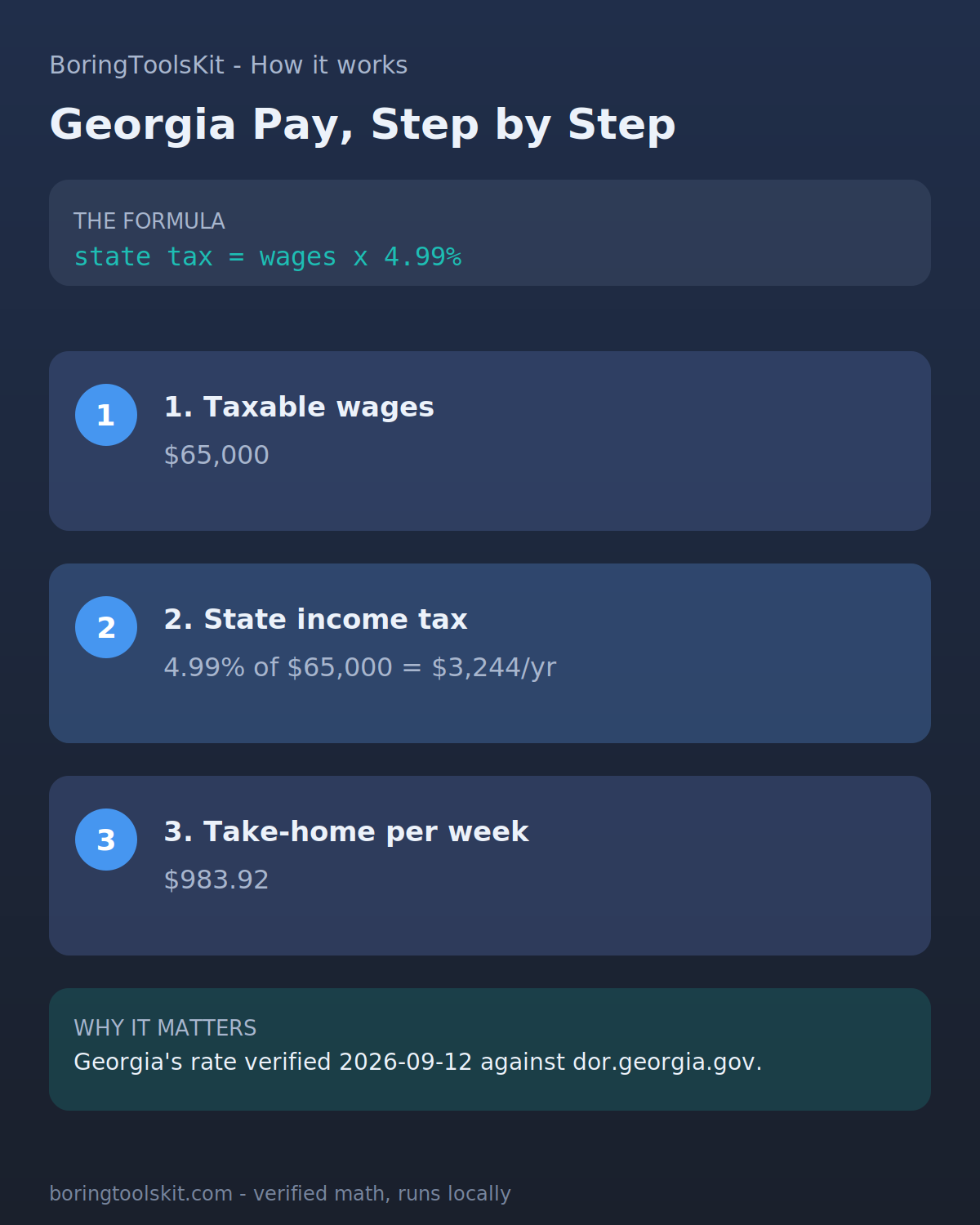
Georgia taxes wages at a flat 4.99%. Federal income tax uses 2026 single-filer brackets with the $16,100 standard deduction; FICA is 6.2% Social Security (up to $184,500 of wages) plus 1.45% Medicare.
Calculator
Estimated take-home per paycheck
-
-
| Line | Per paycheck |
|---|---|
| Gross | - |
| Pre-tax deductions | - |
| Federal income tax | - |
| State income tax | - |
| FICA (SS + Medicare) | - |
Effective combined income-tax rate: -
How the state tax is sliced
| Rate | Taxed slice | Tax |
|---|
Single-filer illustration with the standard deduction; excludes credits, exemptions, retirement catch-ups, and local/city taxes. State rate verified 2026-09-12 against the state's own document: dor.georgia.gov 2026 Employer's Tax Guide - rate reduced 5.19% to 4.99% effective May 11, 2026 Tax year 2026; verify with the Georgia revenue department. Not tax advice.
How this estimate works
Annual gross minus pre-tax 401(k)/health contributions minus the standard deduction is taxed through the 2026 federal single-filer brackets. Social Security takes 6.2% of gross wages up to $184,500; Medicare takes 1.45% of all wages (0.9% additional above $200,000 single). State income tax applies the Georgia table to wages after pre-tax deductions. Everything divides by your pay frequency.
See the full Georgia bracket table or the federal paycheck calculator.
Georgia's flat income tax and what it changes in your withholding
Georgia moved to a flat income tax structure, so the state withholding calculation is conceptually simpler than a graduated schedule: your taxable wages are taxed at the same rate from the first dollar to the last, subject to the deductions and exemptions on Georgia Form G-4. The calculator applies a single state rate to the adjusted wage base rather than bracketing income into slices, which means a $38,000 earner and an $88,000 earner pay the same percentage in state tax, unlike the federal tax line where the 88,000 salary stretches across multiple brackets.
That flat structure has a real consequence for planning: raising your salary raises your Georgia tax line linearly, so the marginal state cost of a raise is easy to predict. A $5,000 raise costs roughly a fixed percentage of the extra amount in Georgia tax, regardless of where your salary started. The federal withholding on that same raise, by contrast, may land in a higher bracket and cost proportionally more. When you interpret the calculator's output, look at the state line for simplicity and the federal line for nuance; the two behave differently by design of the underlying tax law, not by any choice the calculator made.
Form G-4 is Georgia's version of the W-4, and it works differently
Georgia employees file Georgia Form G-4, not the federal W-4, to control state withholding. The form lets you claim dependents, an additional allowance for yourself or a spouse, and in some cases an extra dollar amount per period. The state uses an allowance-based reduction of the taxable base rather than the revised federal credit-based approach, so the numbers on a W-4 do not translate directly into G-4 entries. New hires must complete a G-4 for Georgia withholding even if their federal W-4 is already on file.
A G-4 with zero dependents produces substantially more withholding than one with several claimed dependents, because dependents reduce the taxable base before the flat rate applies. The calculator takes an allowances or dependents input for this reason, and it is the second most common cause of a mismatched estimate. The most common cause is a pretax deduction the user did not enter: Georgia allows most Section 125 plans and qualified 401(k) contributions to reduce the wage base, so a person putting $300 a pay period into a 401(k) sees a noticeably smaller state tax line than a person earning the same gross with no pretax deductions. If the estimate looks high, add the pretax amounts before adjusting allowances.
A worked scenario: $52,000 salary, paid twice a month
Take a single employee in Georgia earning $52,000 a year, paid semimonthly, with one dependent claimed and a $150 per pay period health premium treated as pretax. The gross is $2,166.67 per pay period. Georgia withholding first subtracts the pretax health premium and the allowance amount associated with the dependent from that gross, then applies the flat state rate to what remains. Federal withholding runs on the W-4 first, then FICA is calculated at the statutory rates, and Social Security applies to wages with no deduction for the health premium.
Running these numbers through the calculator produces a take-home estimate a bit under $1,700 per period as an illustrative result; the exact figure depends on the flat rate schedule for the current year and the dependent allowance amount on the G-4. Multiply by 24 periods for the annual view. Note what does not scale: the health premium amount is a fixed dollar figure, so a modest raise does not change the pretax amount but does change both the federal and Georgia tax lines. If this person instead contributed $300 per period to a 401(k), both tax lines would shrink and the take-home would drop less than the contribution amount, because part of the contribution comes out of what would otherwise have gone to state and federal tax.
Two edge cases where the Georgia estimate lands wide
The first edge case is salary above the current federal projected thresholds for the additional Medicare tax and the Social Security wage base. Once Social Security contributions stop partway through the year, the calculator would need to know how many pay periods have already occurred. It does not track that. A person earning $185,000 who starts the estimate in the middle of the year will see a slightly different FICA burden than a person earning the same total from January. In both cases the estimate is an approximation of the annual figure, not a running-of-the-year figure.
The second edge case is non-resident employees working for a Georgia employer. A person who lives across the border in Alabama or Tennessee but works full-time in Georgia is generally subject to Georgia income tax on wages earned in the state, though some states have reciprocal agreements that simplify things. Georgia does have reciprocal agreements with some neighboring states, and the calculator does not attempt to model a reciprocal agreement, a partially lived-in state, a position that qualifies as a non-resident contract work, or any filing situation that involves a two-state return. If your situation spans states, treat the Georgia output as a single-state view and get a municipally exact answer from a CPA before signing anything that quotes a net figure.
Three concrete ways to use the Georgia paycheck estimate
One: sanity-check a job offer. A $58,000 offer in the Atlanta suburbs and a $58,000 offer somewhere with a lower cost of living produce identical Georgia tax lines because the tax is flat; what changes between locations is your federal brackets are intact and your actual spending. Seeing the after-tax number removes the gross figure from the negotiation and replaces it with something you can compare monthly rent against.
Two: compare a pretax versus Roth 401(k) choice. Because Georgia applies its flat rate after pretax deductions, contributing to a traditional 401(k) reduces both federal and Georgia withholding; contributing to a Roth version does not reduce the Georgia line. The calculator cannot tell you which saves more over decades, but it can show you exactly how big the immediate difference is per pay period, which is the number people underestimate.
Three: budget by what lands in the account, not by what is earned. If the state and federal withholding bring a $64,000 salary down to roughly $4,050 a month (a hypothetical figure produced by the calculator using typical deductions), any automatic transfer, rent target, or debt payment plan should be keyed to the $4,050 figure, not the $5,333 monthly gross. Budgeting on the gross figure leads people to run up credit card balances in the last week of a pay cycle, a pattern that then feeds the debt calculators elsewhere on this site.