Foundation Repair Cost Calculator
Foundation problems only get worse and more expensive. This estimates repair cost by repair method — crack injection, slab leveling, or piering — so you understand the scale before calling an engineer.
What does this tool do?
Foundation Repair Cost Calculator computes the result directly in your browser — Foundation problems only get worse and more expensive. This estimates repair cost by repair method — crack injection, slab leveling, or piering — so you understand the scale before calling an engineer. Nothing you enter is uploaded or stored.
Method drives price: crack injection ≈$150-350/crack, slab leveling ≈$1,000-5,000, piering ≈$1,200-2,500/pier in 2026 examples. Always start with an engineer's inspection (~$400-800) — the right diagnosis determines whether you need the $300 fix or the $15,000 one. Regional: 0.85× rural to 1.35× metro. Don't delay: water intrusion and settlement worsen without repair.
How this calculator works
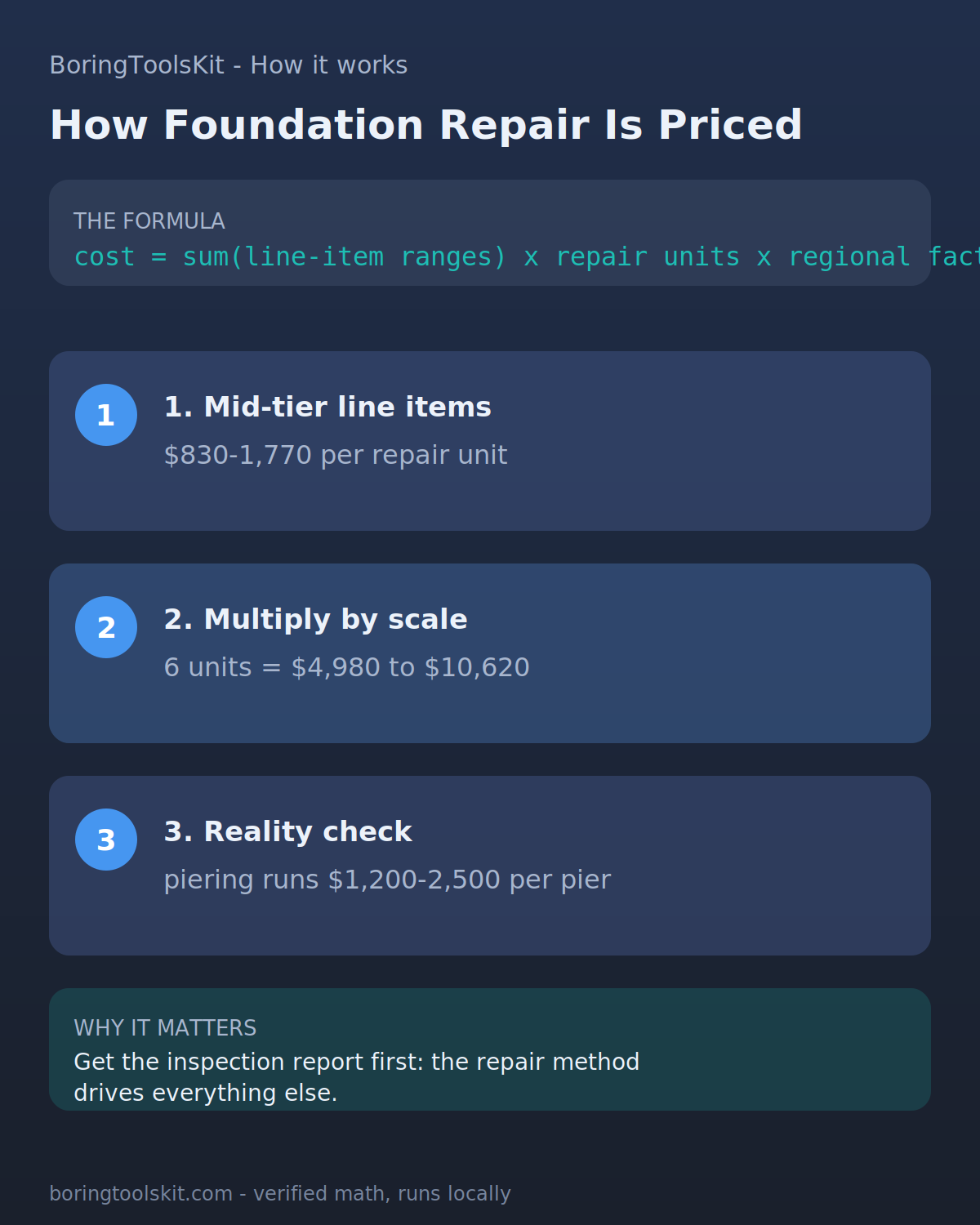
cost = sum(line-item ranges per repair unit) x size x regional factor. Mid-tier items: Slab leveling (per linear ft) $30-70, Mudjacking / polyurethane $400-900, Inspection & report $400-800.
Worked example
A 6 repair unit project at mid tier with the national labor factor (1.0): line items sum to $4,980-$10,620, midpoint about $7,800. Try these numbers in the calculator above; adjust the regional multiplier for your metro.
What drives foundation repair cost most
The repair method sets the range. Crack injection runs about $150 to $350 per crack, mudjacking or polyurethane foam runs $400 to $900, and slab leveling runs $1,000 to $5,000, or $30 to $70 per linear foot. Piering is the big one: $1,200 to $2,500 per pier, so a 6-pier house can land between $7,000 and $15,000.
Scale matters more than any single line item. Injecting one crack is the smallest job on this page; a settling house on piers runs $7,000 to $15,000. The inspection and report, $400 to $800, is a small slice of a piering job but a large share of a single-crack repair. The underlying cause, soil, water, or settlement, decides which method fits and how many repair units you pay for.
How to keep your foundation repair budget honest
Start with an accurate size input. Count cracks, measure the linear feet of slab that needs leveling, and count piers if an engineer has specified them, because each pier adds $1,200 to $2,500. Set the regional labor multiplier honestly: 0.85 fits low-cost rural markets, 1.35 fits major metros, and the difference shows up most on labor-heavy piering jobs.
Pick the tier that matches your actual diagnosis, not your fear. If the problem is one hairline crack, the low tier with a $150 to $350 injection is realistic; skip the expensive fix unless an engineer's report calls for it. Use DIY mode only for cosmetic patching, and always budget the $400 to $800 inspection first, since a written spec is what stops contractors from overselling.
FAQ
How much does foundation repair cost?
From about $300 for a simple crack injection to $7,000-$15,000 for piering a settling house, in 2026 examples. The exact cost depends on the method and the cause — get an engineer's diagnosis first.
Do I need a structural engineer?
For anything beyond a single hairline crack, yes. An engineer (~$400-800) identifies the cause — soil, water, or settlement — and writes the repair spec. Contractors who skip the inspection often oversell the expensive fix.
Is foundation repair covered by insurance?
Usually not — most policies exclude earth movement and gradual settlement. Water-damage-related repairs may be covered. Read your policy and check with your agent before assuming coverage.
These are editable example ranges for budgeting, not contractor bids. Actual project cost varies by region, site condition, and finish level. Get 3 quotes before committing.