Feed Conversion Ratio Calculator
Feed is your biggest livestock cost. FCR tells you how efficiently animals convert feed to gain, and cost of gain puts a dollar figure on every pound. Both are essential for margins.
What does this tool do?
Feed Conversion Ratio Calculator computes the result directly in your browser — Feed is your biggest livestock cost. FCR tells you how efficiently animals convert feed to gain, and cost of gain puts a dollar figure on every pound. Both are essential for margins. Nothing you enter is uploaded or stored.
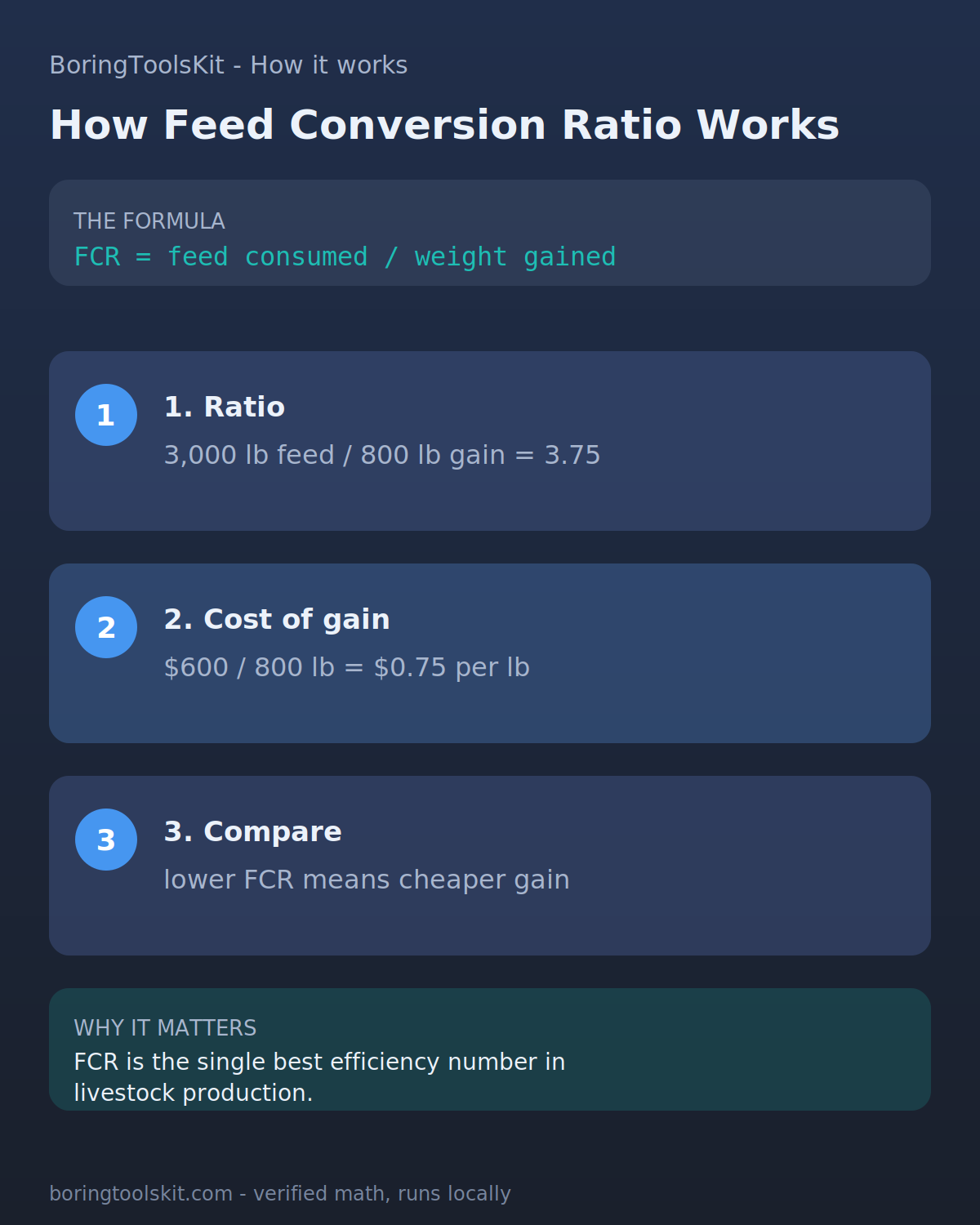
Formula: FCR = feed consumed (lb) ÷ weight gained (lb). Cost of gain = total feed cost ÷ pounds gained. Lower is better: poultry ~1.5-2, swine ~2.5-3, grain-fed beef ~6-8 in typical operations — species and stage of production differ widely. Include all feed: grain, forage/hay, supplements, and waste. Forage-fed systems need dry-matter basis for an honest comparison. Use: compare FCR and cost of gain across pens, rations, or genetics to find where feed dollars are leaking.
How this calculator works
Formula: FCR = feed consumed (lb) ÷ weight gained (lb). Cost of gain = total feed cost ÷ pounds gained. Lower is better: poultry ~1.5-2, swine ~2.5-3, grain-fed beef ~6-8 in typical operations — species and stage of production differ widely. Include all feed: grain, forage/hay, supplements, and waste. Forage-fed systems need dry-matter basis for an honest comparison. Use: compare FCR and cost of
Worked example
3,000 lb of feed producing 800 lb of gain: FCR = 3.75 (3,000 / 800). At $600 of feed, cost of gain is $0.75/lb ($600 / 800).
FAQ
What is a good feed conversion ratio?
It depends on species: poultry runs ~1.5-2, swine ~2.5-3, and grain-fed beef ~6-8. Lower is more efficient — the same gain on less feed.
How do I calculate cost of gain?
Divide the total feed cost by the total pounds gained. It tells you the feed cost embedded in each pound of animal you produce — the key number for marketing and breakeven.
Does forage vs grain change FCR?
Yes — animals on high-forage rations convert feed to gain less efficiently by weight than on grain, but forage is cheaper per pound. Compare on dry-matter and cost basis, not just FCR.
Figures are editable example defaults for planning, not guarantees. Crop inputs, prices, and moisture handling vary by farm, region, and year — verify with your local extension service and agronomist.