Electrical Wiring Cost Calculator
Wiring a home or rewiring an old one is a major job priced largely by square footage and finish (rough-in vs full drywall repair). This estimates your range.
What does this tool do?
Electrical Wiring Cost Calculator computes the result directly in your browser — Wiring a home or rewiring an old one is a major job priced largely by square footage and finish (rough-in vs full drywall repair). This estimates your range. Nothing you enter is uploaded or stored.
What moves cost most: finish level — running wire in open walls (rough-in) is far cheaper than opening and patching finished drywall. Labor share: 60-75% of the total. Regional: 0.85× rural to 1.35× metro. Trigger: aluminum wiring, cloth-insulated wire, or a panel that trips on normal load are reasons to rewire.
How this calculator works
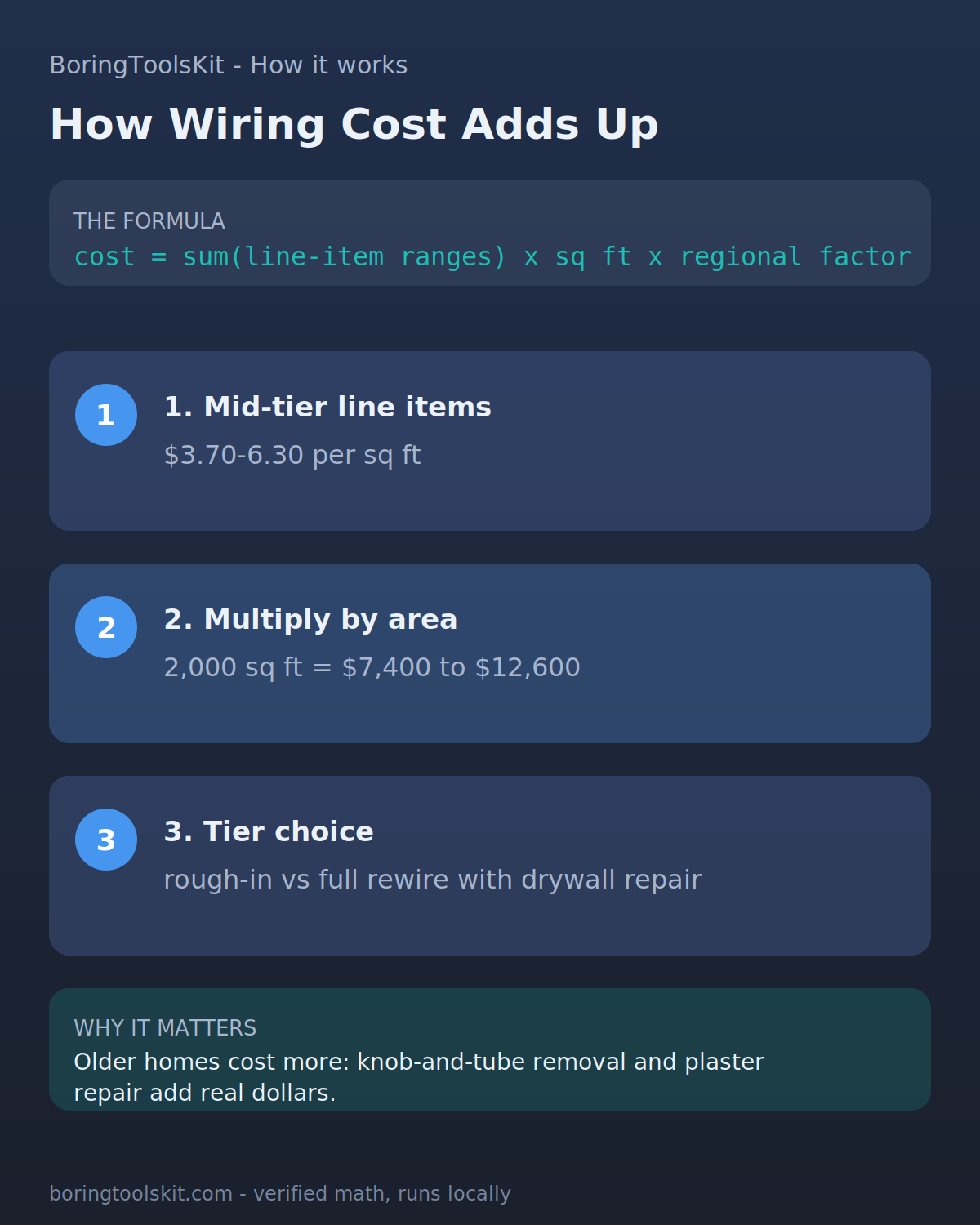
cost = sum(line-item ranges per sq ft) x size x regional factor. Mid-tier items: Wire & materials $0.9-1.5, Rough-in + device labor $2.0-3.2, Drywall patch & paint $0.8-1.6.
Worked example
A 2000 sq ft project at mid tier with the national labor factor (1.0): line items sum to $7,400-$12,600, midpoint about $10,000. Try these numbers in the calculator above; adjust the regional multiplier for your metro.
What drives electrical rewiring cost most
Three line items make up the estimate, shown at mid tier. Rough-in and device labor runs $2.00-$3.20 per sq ft and is the largest piece, roughly half of the total. Wire and materials add $0.90-$1.50 per sq ft. Drywall patch and paint adds $0.80-$1.60 per sq ft and only applies when walls are finished, since open walls need no repair.
That is why the 2026 example range is about $2-$7 per sq ft for rough-in on open walls and $4-$10 per sq ft when drywall repair is included. On a 2,000 sq ft house, a full rewire of a finished home lands near $8,000-$20,000. New construction skips the patch work entirely, which keeps the lower end of that scale realistic.
How to keep your rewiring budget honest
Measure your finished square footage accurately before you run numbers, since every line item scales with it. Set the regional labor multiplier to match your area; it spans 0.85 to 1.35, and labor is the largest cost, so a wrong setting moves the whole estimate. Pick the tier that matches your walls: rough-in only if the drywall is already open.
Use DIY mode only for what you can legally and safely handle, such as running cable during a gut renovation, and leave panel work and connections to a licensed electrician. If your home has cloth-insulated wire, aluminum wiring, or no grounded outlets, get an electrician to assess it before pricing, because those findings change the scope more than any calculator setting.
FAQ
How much does it cost to rewire a house?
Roughly $4-$10 per square foot in 2026 examples for a full rewire of a finished home — about $8,000-$20,000 for a 2,000 sq ft house. Rough-in on new construction is cheaper at $2-$7/sq ft.
What is the difference between rough-in and rewire?
Rough-in is running wire in open walls during new construction or a gut renovation — no drywall damage. Rewire of an occupied home means opening walls, patching, and painting, which roughly doubles the cost.
How do I know my house needs rewiring?
Cloth-insulated wire, aluminum wiring, a panel that trips on normal loads, or no grounded outlets in an older home are all reasons to have an electrician assess a rewire. Don't wait for a smell or spark.
These are editable example ranges for budgeting, not contractor bids. Actual project cost varies by region, site condition, and finish level. Get 3 quotes before committing.