Electrical Panel Upgrade Cost Calculator
An outdated electrical panel is a safety risk and a blocker for EV chargers, heat pumps, and additions. This estimates the cost to upgrade by service size and panel quality.
What does this tool do?
Electrical Panel Upgrade Cost Calculator computes the result directly in your browser — An outdated electrical panel is a safety risk and a blocker for EV chargers, heat pumps, and additions. This estimates the cost to upgrade by service size and panel quality. Nothing you enter is uploaded or stored.
Service size drives price: 100A ≈$1,100-2,100, 200A ≈$1,800-3,500, 400A ≈$3,700-7,100 in 2026 examples. What moves cost most: service size, whether the meter/mast must move, and the number of new circuits. Regional: 0.85× rural to 1.35× metro. Safety: never DIY panel work — it's a code + fire risk; use a licensed electrician.
How this calculator works
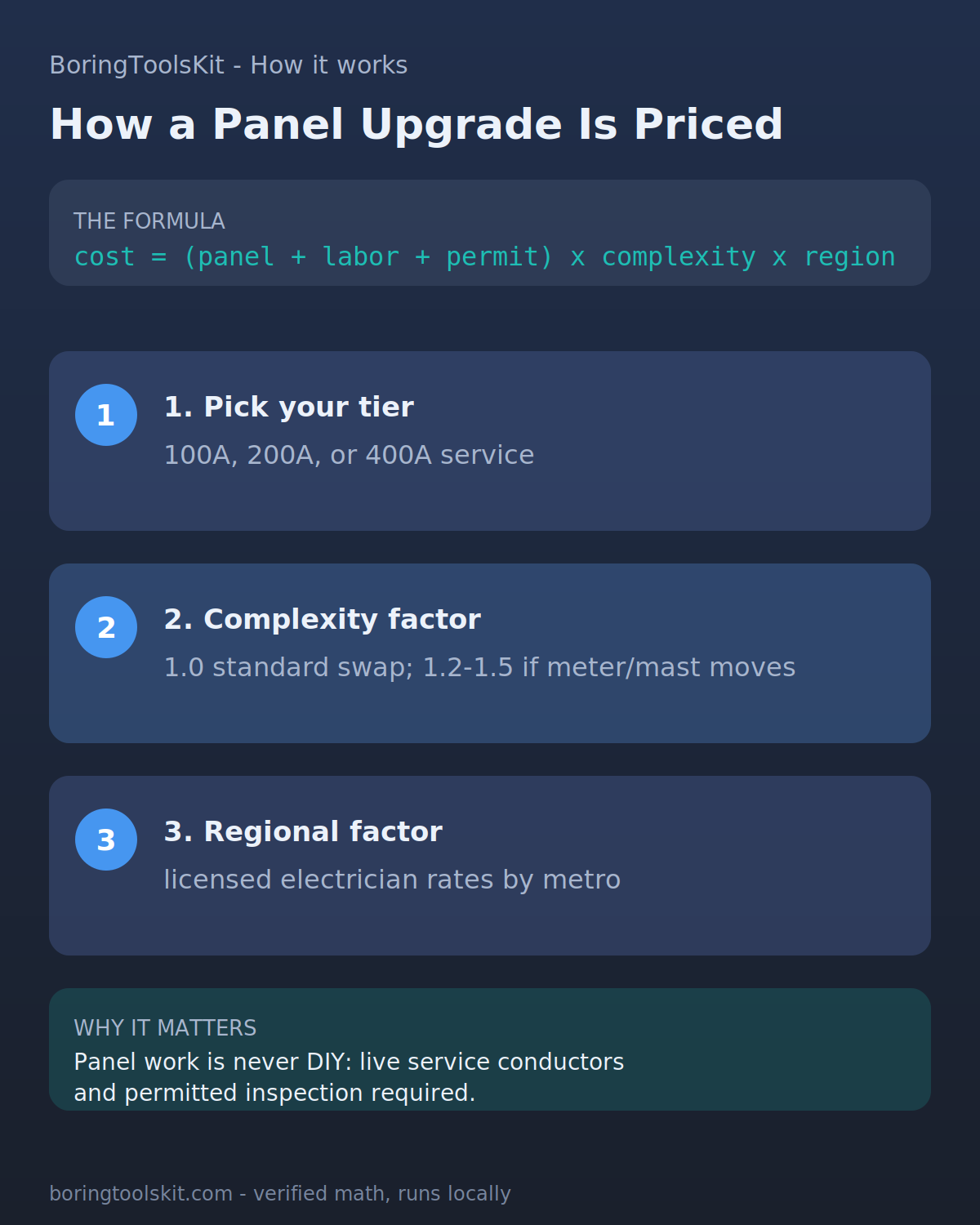
cost = sum(line-item ranges per job) x size x regional factor. Mid-tier items: Panel + breakers (200A) $700-1300, Labor (with meter/service) $900-1800, Permit & inspection $150-400.
Worked example
A 1 job project at mid tier with the national labor factor (1.0): line items sum to $1,750-$3,500, midpoint about $2,625. Try these numbers in the calculator above; adjust the regional multiplier for your metro.
What drives electrical panel upgrade cost most
Labor is the biggest driver. Wiring a 200-amp panel, including meter and service work, runs $900 to $1,800, about half of the total. The panel and breakers themselves cost $700 to $1,300, and the permit and inspection adds $150 to $400. Stack those mid-tier numbers together and you land near the $1,800 to $3,500 range for a standard 200-amp upgrade.
Size moves the numbers fast. A 400-amp service runs $3,700 to $7,100 in the same 2026 examples, roughly double the 200-amp job, because heavier service conductors and a larger panel raise both parts and labor. Relocating the meter or service mast, adding circuits, or rewiring a section of the home each add cost on top of the base range.
How to keep your electrical panel upgrade budget honest
Start with the service size you actually need, not the biggest one. Most homes with an EV charger and a heat pump fit 200 amps; a load calculation from your electrician confirms it. Then check the regional labor multiplier. At 0.85 you pay less than the base estimate; at 1.35 you can pay more than a third above it, so location alone can swing the labor line by hundreds of dollars.
Pick the tier that matches your home, and keep labor in the estimate. A mid-tier build matches the example range of $1,800 to $3,500 for 200 amps. The DIY mode is handy for seeing what parts alone cost, but panel work is not a real do-it-yourself job: it involves live service conductors and requires a permitted inspection by a licensed electrician. Treat the DIY figure as a parts price check, nothing more.
FAQ
How much does a 200-amp panel upgrade cost?
About $1,800-$3,500 in 2026 examples, including panel, breakers, labor, and permit. The cost jumps if the meter or service mast must be relocated.
Do I need a 200-amp or 400-amp panel?
200 amps handles a typical modern home including an EV charger and heat pump. Go 400 amps for large all-electric homes, multi-unit dwellings, or significant additions. Your electrician sizes it from a load calculation.
Is an electrical panel upgrade DIY?
No. Panel work involves live service conductors and must meet code with a permitted inspection. It's a genuine safety risk — always use a licensed electrician.
These are editable example ranges for budgeting, not contractor bids. Actual project cost varies by region, site condition, and finish level. Get 3 quotes before committing.