Drip Irrigation Calculator
Drip delivers water slowly at each emitter, which is ideal for beds, rows, and containers. Enter your emitters and their flow to size the zone and set run time.
What does this tool do?
Drip Irrigation Calculator computes the result directly in your browser — Drip delivers water slowly at each emitter, which is ideal for beds, rows, and containers. Enter your emitters and their flow to size the zone and set run time. Nothing you enter is uploaded or stored.
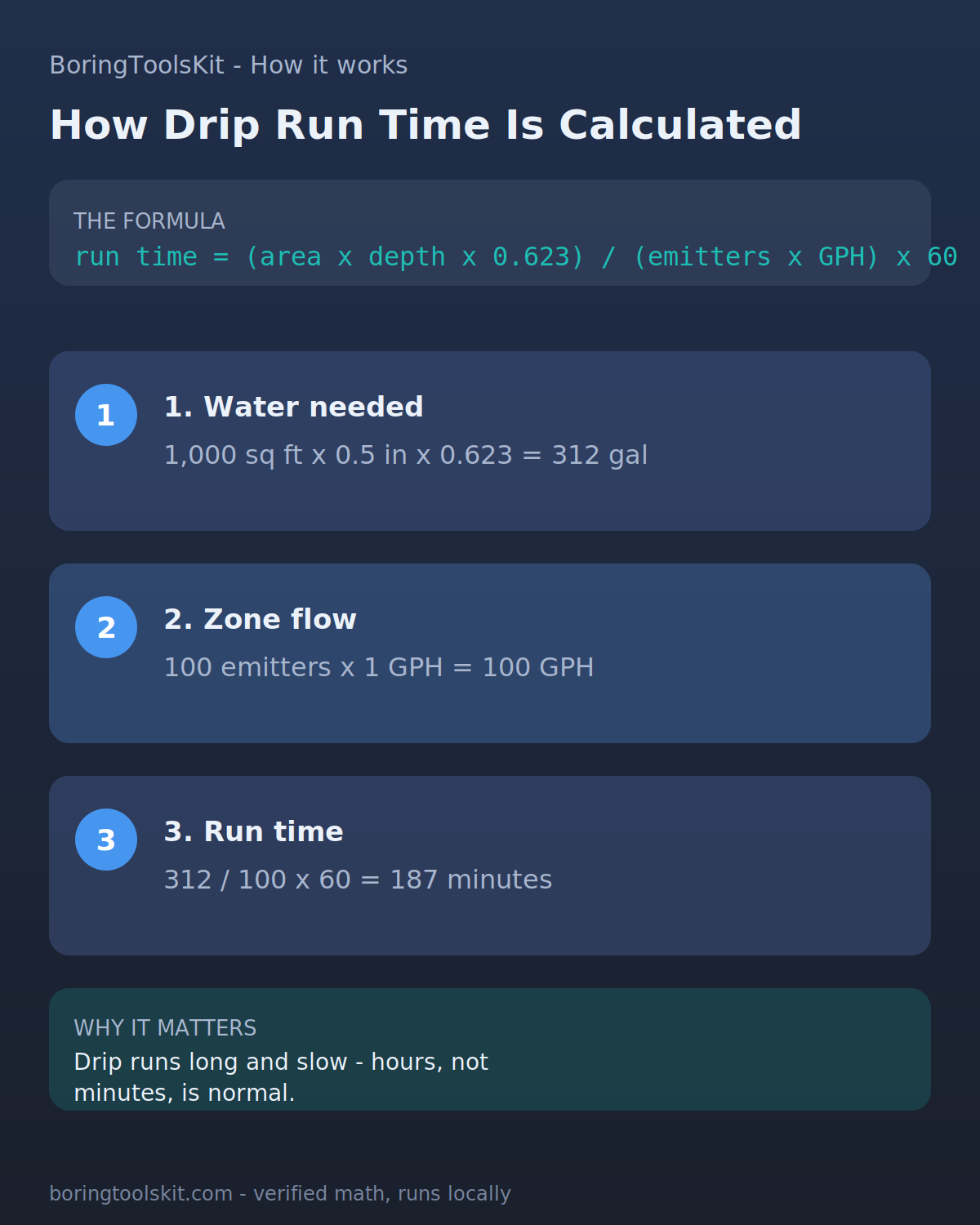
Formula: total zone flow (GPH) = emitters × flow per emitter; water needed = area × depth × 0.623; run time (min) = water needed ÷ total flow × 60. Use: size the zone against your line's capacity, then set run time to replace ET minus rainfall. Drip minimizes evaporation and runoff — a genuine water-saving upgrade over sprinklers on beds and rows.
How this calculator works
Formula: total zone flow (GPH) = emitters × flow per emitter; water needed = area × depth × 0.623; run time (min) = water needed ÷ total flow × 60. Use: size the zone against your line's capacity, then set run time to replace ET minus rainfall. Drip minimizes evaporation and runoff — a genuine water-saving upgrade over sprinklers on beds and rows.
Worked example
100 emitters at 1.0 GPH give a zone flow of 100 GPH (1.67 GPM). A 1,000 sq ft bed at 0.5 inches needs 312 gallons (1,000 x 0.5 x 0.623), which is about 187 minutes of run time.
What actually drives your run time
Two multiplications set the answer. Total zone flow is the number of emitters times the flow per emitter, so 100 emitters at 1 GPH supply 100 GPH. Water needed is the irrigated area times the depth times 0.623, the factor that converts one inch of water over one square foot into gallons. Run time divides those gallons by total flow and multiplies by 60 to get minutes.
Each input moves the result in a predictable way. Double the emitter count and run time is cut in half; double the target depth and it doubles. Depth matters most in practice because hardware fixes the other side: emitters and their flow rarely change once installed. For scale, a bed of 100 square feet watered one inch deep needs about 62 gallons, which a 100 GPH zone delivers in roughly 37 minutes.
Practical advice for sizing and scheduling
Start with the flow input. Typical emitters run 0.5 to 2 GPH, and a zone of 100 emitters at 1 GPH draws about 1.67 GPM. Compare your total zone flow to what your supply line and valve can deliver before adding emitters; exceeding capacity starves emitters at the far end. If the calculated run time feels long, adding emitters or stepping up the flow rate shortens it.
Treat the depth input as a schedule, not a constant. Set it to replace evapotranspiration minus any rainfall, then water deeply and less often rather than in frequent shallow cycles. Because drip runs about 90% efficient against 70 to 80% for sprinklers, and keeps foliage dry to reduce disease, the depth you enter goes into the soil rather than the air. Recalculate the area input as beds expand.
FAQ
How much water does a drip emitter use?
A typical emitter flows 0.5-2 gallons per hour. A zone of 100 emitters at 1 GPH delivers 100 GPH (about 1.67 GPM).
How long should I run drip irrigation?
Divide the gallons your area needs by the zone's total flow. For 500 gal needed at 100 GPH, run about 30 minutes. Deep, less frequent watering is generally better than frequent shallow cycles.
Is drip better than sprinklers?
Drip is roughly 90% efficient (less evaporation and runoff) versus 70-80% for sprinklers, and it keeps foliage dry, reducing disease. It costs more to install but often pays off in water savings on beds, rows, and containers.
Figures are editable example defaults for planning, not guarantees. Water needs vary by crop, soil, weather, season, and local climate — check ET data (NOAA, your state CIMIS/AgriMet network) and verify with your local extension service or agronomist.