Carriers bill by the greater of actual weight or dimensional weight — how much space your package takes up. Oversized light boxes cost more than their actual pounds. This finds your billable weight and the cost impact.
Direct answer
What does this tool do?
Dimensional Weight Calculator computes the result directly in your browser — Carriers bill by the greater of actual weight or dimensional weight — how much space your package takes up. Oversized light boxes cost more than their actual pounds. This finds your billable weight and the cost impact. Nothing you enter is uploaded or stored.
Formula: dimensional weight = length × width × height (inches) ÷ divisor. Common divisors: 166 for USPS retail, 139 for UPS/FedEx daily rates. Billable: carriers charge the greater of actual or DIM weight, rounded up per package. Why it matters: a 2-lb item in an 18×14×12 box has DIM 18.2 lb (÷166) — a 9x cost jump. Consolidating or right-sizing boxes is the cheapest shipping optimization for light bulky items.
How this calculator works
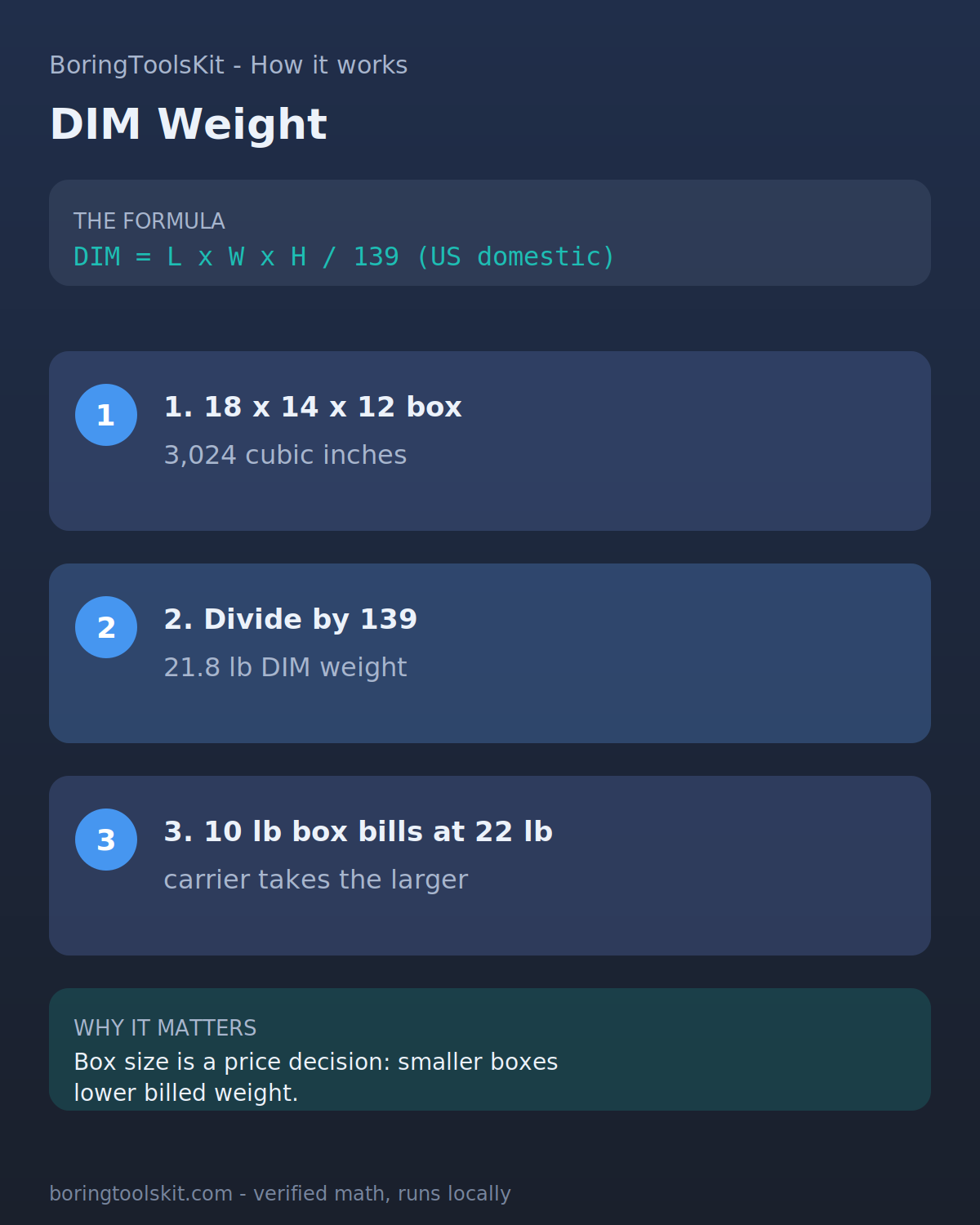
DIM weight = L x W x H (inches) / 139 (US domestic divisor). Billed weight = max(actual weight, DIM weight).
Worked example
A 18x14x12 box (3,024 cubic inches) has a DIM weight of 21.8 lb; if the box weighs 10 lb, you are billed for 22 lb.
Carriers bill the larger of actual and dimensional weight: box size is a price decision.
FAQ
What is dimensional weight?
A billing measure based on package volume instead of actual weight: length × width × height ÷ a carrier divisor. Carriers charge the greater of actual or DIM weight.
Why is my shipping cost so high for a light package?
Likely DIM weight. A light but oversized box bills at its volume-based weight, which can be many times its actual pounds. Use the smallest box that fits.
What divisor should I use?
USPS retail uses 166; UPS and FedEx daily rates use 139 (so DIM weight is higher). Your negotiated rate card may differ — use the divisor your carrier contract specifies.
Figures are editable example defaults for modeling, not quotes or advice. Financial, tax, and medical outcomes vary with your situation — verify with a qualified professional (CFP, CPA, tax advisor, or veterinarian).
Use this result
Share the current inputs or ask ChatGPT to explain the calculation in context.
Take a 16 x 12 x 10 inch box weighing 12 lb on the scale. Volume is 16 x 12 x 10 = 1,920 cubic inches. Divided by the UPS/FedEx daily-rate divisor of 139, dimensional weight is 1,920 / 139 = 13.8 lb. Divided by the USPS retail divisor of 166, it is 1,920 / 166 = 11.6 lb.
Carriers round up, so with the 139 divisor you are billed for 14 lb even though the scale reads 12 lb. Under the 166 divisor the DIM weight of 11.6 lb rounds to 12 lb, which equals the actual weight, so actual weight governs and the box is billed at 12 lb. Same physical box, same scale reading: the divisor alone moves the billable weight from 12 lb to 14 lb, a 17% difference. That is why a negotiated contract divisor matters more than any single quote: some negotiated rate cards use 166 instead of 139, and some use 194 for very small packages.
You can check whether DIM weight is in play before shipping: divide your box volume by 139. If the result is below the actual weight, dimensional weight is not your constraint and the smaller box buys nothing. Above it, every cubic inch you shave lowers the bill.
Where the savings hide: inches and rounding
Dimensional weight is unforgiving at the edges because carriers measure packaging, not contents. A 14 x 12 x 10 box measures 1,680 cubic inches and 12.1 lb DIM at divisor 139. Cut just one inch from the length and you get 13 x 12 x 10 = 1,560 cubic inches, or 11.2 lb DIM: a 6% smaller box that drops the billable figure by nearly a pound once rounding is applied.
Rounding works against you at thresholds. A box measuring 1,387 cubic inches divides to 9.98 lb DIM, which rounds to a billed 10 lb; shave 28 cubic inches and it divides to 9.78, still billed as 10 lb. Shave 28 more, to 1,331, and you drop to 9.6 lb DIM, billed at 10 lb again until you cross 1,390 cubic inches. In practice the cheapest move is measuring packed boxes, not empty ones: bulging flaps and a single wrap of tape commonly add a half inch per side, turning a 12-inch dimension into 13 and inflating volume by 8 to 10%.
Also note the billable comparison happens after both weights are rounded. An actual weight of 9.4 lb billed as 10 lb against DIM 9.6 lb billed as 10 lb means neither number is the tiebreaker; the box geometry is.