US and imperial fluid ounces are different units. Choose the system used by your container or recipe.
Calculated in your browser; your inputs are not sent to us. Privacy
Results update when you run the tool.
This tool processes the selected input in your browser. Review the output before relying on it; format and file behavior can vary by browser and source data.
Your inputs and results stay in this browser. This page may send privacy-bounded aggregate interaction events described in Privacy; it does not send your entered values or result contents.
Use this result
Share the current inputs or ask ChatGPT to explain the calculation in context.
More options
What does this converter do?
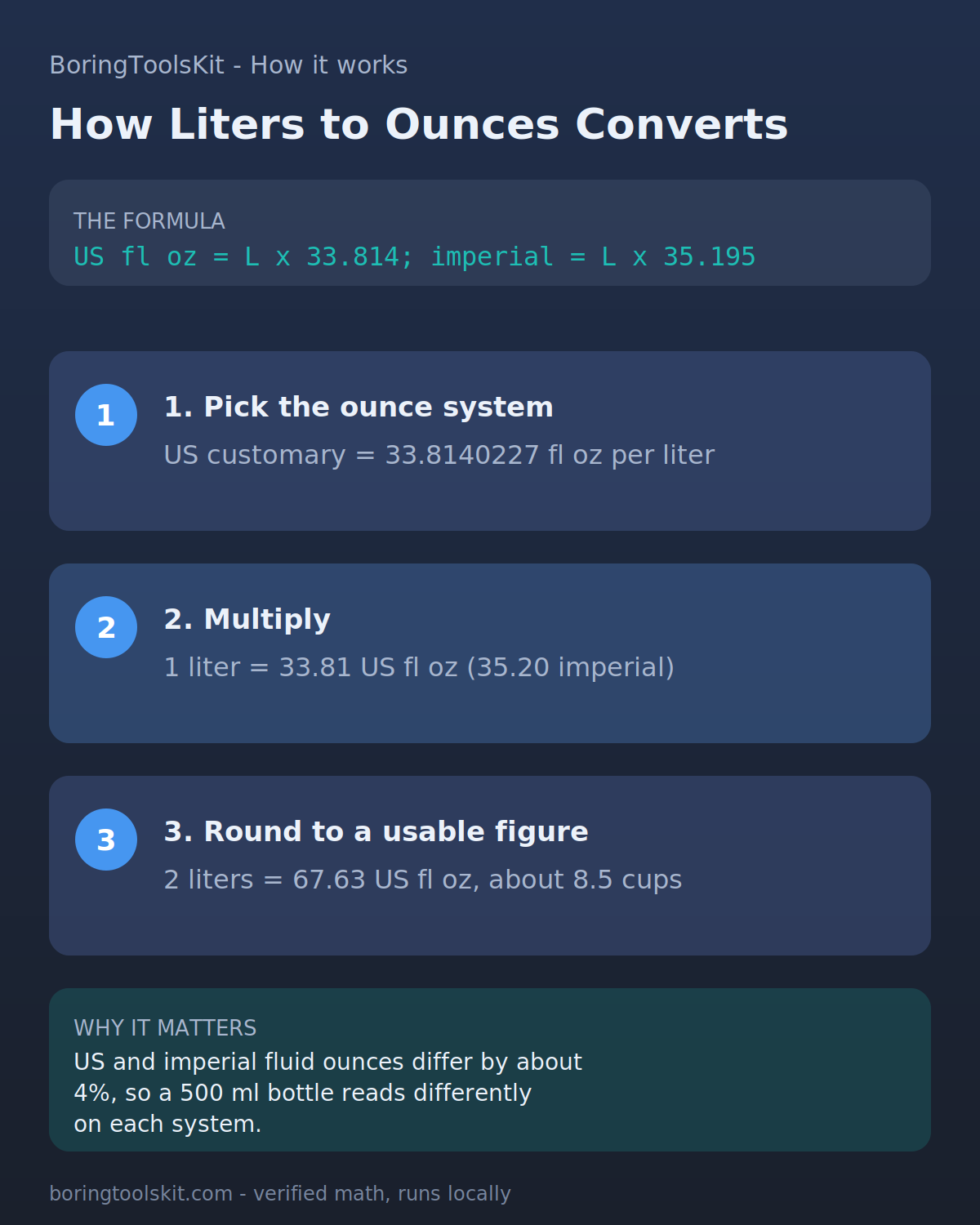
1 liter equals 33.814 US fluid ounces. That makes 2 liters 67.63 fl oz and half a liter 16.907 fl oz. The conversion is exact under the US definition of the gallon, so enter any liter value in the BoringToolsKit liters to ounces converter for the precise result.
- 1 US gallon is defined as 3.785411784 liters, which fixes 1 liter at 33.8140227 US fluid ounces. (Source: NIST)
- US fluid ounces differ from imperial fluid ounces: 1 imperial ounce is about 28.41 mL versus 29.57 mL for US. (Source: NIST)
- Recipe conversions under half a liter round cleanly: 250 mL is about 8.45 US fl oz. (Source: NIST)
- One US quart is 32 US fluid ounces, so a liter holds 1.81 fl oz more than a quart. (Source: NIST)
- The imperial fluid ounce is defined as exactly 28.4130625 mL (160 per imperial gallon of 4.54609 L), versus 29.5735295625 mL for the US fluid ounce. (Source: NIST)
Kitchen and baking conversions between liters and fluid ounces
American recipes and packaging speak in fluid ounces while measuring jugs sold for metric markets are marked in milliliters and liters, so the two scales have to meet mid-recipe. One US legal cup is defined as 240 mL, which measures 8.1154 US fl oz, while the informal 8-ounce cup holds 236.6 mL. Half a liter of cream pours 16.91 fl oz, a standard 750 mL wine bottle holds 25.36 fl oz, and a US pint of milk (16 fl oz) is 473.18 mL, which lands just under half a liter.
The table below lists the package sizes that appear most often in kitchens and baking schedules. Because 250 mL rounds to 8.45 fl oz, a 250 mL measuring cup holds a little more than one 8-ounce cup, and doubling or halving a recipe moves you cleanly between rows.
Keep the system straight when a recipe travels: a British recipe calling for half a liter assumes imperial ounces, so its pint measure is not the US pint. When in doubt, enter the liter figure, read the US fluid-ounce result, and check the recipe's country of origin before pouring.
| Metric measure | Liters | US fluid ounces |
|---|---|---|
| 1/8 L (125 mL) | 0.125 | 4.23 |
| 1/4 L (250 mL) | 0.25 | 8.45 |
| 1/2 L (500 mL) | 0.5 | 16.91 |
| 1 L (1000 mL) | 1 | 33.81 |
| 2 L (2000 mL) | 2 | 67.63 |
Hydration goals and medical fluid instructions in liters and ounces
Fluid guidance is the second-biggest reason people convert liters to ounces. MedlinePlus places the daily fluid requirement for most adults between 2.7 and 3.7 liters, which spans 91.30 to 125.11 US fl oz, and counts moisture from food as part of the total rather than glasses of plain water. Household measures make the range tangible: a 2 liter soda bottle holds 67.63 fl oz, a typical 1.9 liter water bottle holds 64.25 fl oz, and four 16.9 fl oz single-serve bottles together just about fill a 2 liter volume.
Clinical instructions usually arrive in ounces while packaged drinks are labeled in milliliters, so the conversion runs in both directions. A direction to drink 64 fl oz per day works out to about 1.89 L, and the common post-procedure example of finishing 5 US quarts by a deadline means 160 fl oz, or 4.73 L. Remember that a US quart holds 32 fl oz while a liter holds 33.81, so each liter poured into a quart bottle overshoots it by about 54 mL.
Athletes and people on fluid restrictions get individual targets from clinicians, and those numbers are worth converting carefully rather than rounding aggressively, because a 5 percent error on a 3.7 liter target is more than 6 fl oz.
| Guideline figure | Liters | US fluid ounces |
|---|---|---|
| MedlinePlus lower adult intake | 2.7 | 91.30 |
| MedlinePlus upper adult intake | 3.7 | 125.11 |
| Typical large water bottle | 1.9 | 64.25 |
| Two-liter soda bottle | 2 | 67.63 |
Engine fuel mixes and other rate-based liter conversions
Small engines run on gasoline premixed with two-stroke oil, and the mix ratio travels across measurement systems: European manuals state ratios in liters while US shop measuring cups are marked in fluid ounces. A 50:1 mix means 20 mL of oil per liter of gasoline, which is 0.68 fl oz per liter, so five liters of fuel needs 100 mL of oil, the same measure as 3.38 fl oz.
The reverse direction trips people up most often: a 4 US fl oz bottle of two-stroke oil contains about 118 mL, which treats 5.91 L of gasoline at 50:1. Bottle sizes and mix ratios also differ by equipment class, so confirm the ratio stamped on the equipment or oil label before measuring, since running a leaner mix than the engine expects can score the cylinder.
| Mix ratio | Oil per 1 L (mL) | Oil per 1 L (US fl oz) | Oil per 5 L (mL) |
|---|---|---|---|
| 50:1 | 20 | 0.68 | 100 |
| 40:1 | 25 | 0.85 | 125 |
| 32:1 | 31.25 | 1.06 | 156.25 |
US fluid ounces versus imperial ounces, with worked numbers
The imperial system defines its gallon as exactly 4.54609 L split into 160 fluid ounces, which works out to 28.4131 mL per imperial ounce, while the US ounce is 29.5735 mL. The ounce difference compounds at container scale: half a liter measures 16.91 US fl oz against 17.60 imperial fl oz, and a 750 mL bottle measures 25.36 US fl oz against 26.40 imperial fl oz.
Pint sizes make the gap obvious in a pub or kitchen. An imperial pint of 20 imperial fluid ounces holds 568 mL, about 20% more than the 473 mL US pint of 16 fluid ounces. The same 2 liter bottle measures 70.39 imperial fl oz instead of the 67.63 US fl oz shown by default in this converter, so switch the system option whenever the recipe, label, or package comes from a country using imperial measures.
| Volume | US fluid ounces | Imperial fluid ounces |
|---|---|---|
| 0.5 L | 16.91 | 17.60 |
| 0.75 L | 25.36 | 26.40 |
| 2 L | 67.63 | 70.39 |
How this calculator works
Formula
Fluid ounces = liters x 33.814 (US fluid ounces; imperial fluid ounces use 35.195).
Assumptions to verify
- This converter outputs US liquid fluid ounces by default and imperial fluid ounces when the Imperial system option is selected; weight ounces are a separate unit entirely.
- Metric system input accepts decimal liters or milliliters, using the standard 1 L = 1000 mL relation.
- Fluid-intake figures in the hydration section reproduce published guideline amounts for healthy adults and are not personalized medical advice.
Frequently asked questions
How many ounces are in a liter exactly?
One liter is exactly 33.8140227 US fluid ounces, fixed by the definition of the US gallon as 3.785411784 liters. The converter multiplies your liter value by that exact factor, so 2 liters return 67.63 fl oz and 0.5 liters return 16.91 fl oz.
How do I convert liters to ounces using this tool?
Simply enter the value in liters, and the tool instantly calculates the equivalent in ounces using the standard conversion factor of 1 liter = 33.814 fluid ounces.
Do I need to sign up or create an account to use this tool?
No, this is a completely no-signup tool. It runs entirely in your browser, so there is no account required and no personal data is collected or stored.
Is the liters to ounces conversion result accurate?
Yes, the conversion uses the standard ratio of 1 liter = 33.814 US fluid ounces, which is a widely accepted and precise conversion factor.
How many ounces is 0.25 liters?
0.25 liters is 8.45 US fluid ounces - just under one cup (1 cup = 8 fl oz = 236.6 mL).
How many ounces is 1.5 liters?
1.5 liters is 50.72 US fluid ounces, which is about 6.3 cups or a little over 3 US pints.
How many fl oz is a 2 liter bottle of soda?
A 2 liter bottle holds 67.63 US fluid ounces, which is about 8.45 eight-ounce cups. Four of the 16.9 fl oz single-serve water bottles sold in US stores come close at 67.6 fl oz, so a 2 liter bottle pours a fraction of an ounce more than four bottles.
Is a US fluid ounce the same as an imperial fluid ounce?
No. One US fluid ounce measures 29.5735 mL while one imperial fluid ounce measures 28.4131 mL, so the same liter fills 33.81 US fl oz but 35.20 imperial fl oz. Half a liter measures 16.91 US fl oz against 17.60 imperial fl oz, a difference of about one ounce on any half-liter pour.
How many ounces are in a US quart?
One US quart is 32 US fluid ounces, so a liter pours 1.81 fl oz more than a quart. A liter carton therefore slightly overfills a quart container, by about 54 mL.
How much oil do I add for a 50:1 fuel mix in liters?
A 50:1 two-stroke mix takes 20 mL of oil per liter of gasoline, which is 0.68 US fluid ounces per liter or 3.38 fl oz (100 mL) per 5 liters. Heavier mixes of 25 mL per liter suit 40:1 ratios and 31.25 mL per liter suits 32:1.
Cite this tool
BoringToolsKit. “Liters to Ounces Converter.” boringtoolskit.com/liters-to-ounces/ (reviewed September 2026). Free to reference in articles, syllabi, and answer posts with a link.
Privacy: Inputs and results stay in this browser. Any future sponsored recommendation or advertisement will be clearly labeled and kept separate from the calculation.