Construction Loan Calculator
Building a home usually means a construction loan that pays interest only while you build, then converts to a permanent mortgage. This models both phases.
What does this tool do?
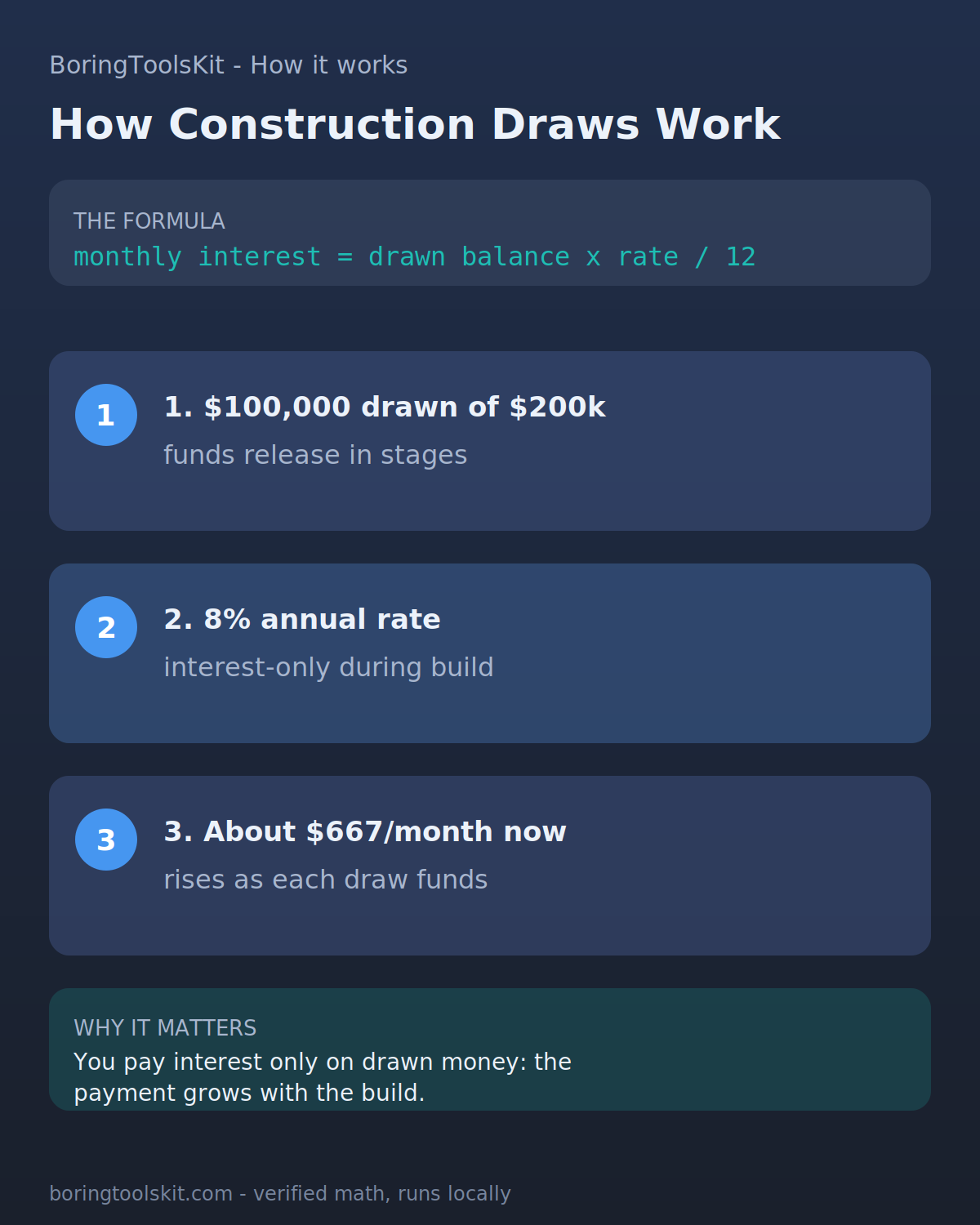
On a $200,000 construction loan at 8% with half the draws released, the interest-only payment on the funded $100,000 is about $667 a month, rising as each additional draw funds. Interest is drawn balance x rate / 12, so you pay only on money actually borrowed rather than the full commitment. Model your draw schedule in the BoringToolsKit construction loan calculator to see how the payment steps up as the build progresses.
- During the draw period the payment is interest-only: drawn balance times the annual rate divided by 12. (Source: BoringToolsKit calculation methodology)
- Draws fund in stages, so the payment grows from about $667 as more of the $200,000 commitment is released. (Source: BoringToolsKit calculation methodology)
- Once construction finishes the balance amortizes as a normal loan with principal and interest. (Source: BoringToolsKit calculation methodology)
How it works: during construction you draw funds as work completes and pay interest only on the outstanding balance. At completion the loan converts to a permanent mortgage (construction-to-permanent) or you pay it off with a new loan. Model: interest on the average outstanding balance (half the build cost), then a fully amortizing permanent payment. Gotchas: construction rates are higher than permanent rates, inspections gate each draw, and cost overruns must be covered out of pocket or with contingency. This is an estimate — your lender's draw schedule and rate lock terms rule.
How this calculator works
Interest-only during the draw period: monthly interest = drawn balance x rate / 12. Payments step up as draws release; the end loan amortizes after completion.
Worked example
$200,000 drawn at 8% with half released: about $667/month interest on the drawn $100,000, rising as more draws fund.
Interest reserve: paying interest on a budget you set aside to pay interest
Construction loans usually contain an interest reserve, a sum set aside inside the loan to cover monthly interest as draws are released. On a $250,000 loan with interest running roughly $900 a month, a four-month reserve is about $3,600 folded into the balance. The effect is subtle: you accrue interest on the reserve itself while it sits there, so the payoff drifts above the sticker loan amount even before any overruns occur.
Two questions are worth putting to a lender before closing. Does the reserve reprice if rates rise, or is it fixed at the closing estimate? A reserve sized at 7% interest but drawn at 9.5% comes up short, and the gap shows up as a borrower wire in the same month the inside-trim draw and subcontractor payments also land. And does unused reserve reduce the payoff at conversion, or does it roll into the permanent note? Ask both, in writing, before the first draw.
How the reserve interacts with draws in this model: the amount shown as interest due each month sits against the reserve first, and only the shortfall leaves your pocket. On the 250,000 example with draws rising from 10,000 a month early on to 60,000 late, monthly interest climbs from about 70 to over 400 before the contractor arrives with the final bill. The reserve absorbs the climb as long as rates behaved, which is why the two failure modes, rate drift and schedule slip, both hit the same line item at once.
Contingency scenarios and the cost of carrying money you may never spend
Builders often price a 10% contingency. On $250,000 of construction that is $25,000 of headroom, but the interest mathematics of contingency differs by contract structure. Under a cost-plus contract the lender funds contingency draws on request; under a fixed-price contract the builder's contingency is inside their bid and invisible to your loan. If the contingency does live inside your loan and it is drawn mid-project, interest at an 8.5% average rate on $12,500 of average drawn contingency for roughly six months runs a few hundred dollars, illustrative but real.
Contract type moves that risk. A guaranteed-maximum-price contract pushes overruns onto the builder; a cost-plus contract pushes them onto you. The lender question that matters is not the headline rate but how the reserve and contingency interact at payoff, since unused contingency may sit in the balance until closing. When comparing two bids that differ by $25,000, check whether one carry interest on contingency you never drew and the other does not.
A cost-plus worked screen: bid base 225,000 plus a 15% builder fee is 258,750, with a 10% contingency near 25,875 on top, so the draw schedule should model about 285,000 of exposure, not 250,000. Interest at 8.5% on average drawn balances across nine months adds roughly 9,000 of carry. A guaranteed-maximum-price alternative quotes a cap near 275,000 with no visible contingency line, which is why the bid with the smaller face number frequently costs more once the model runs.
From certificate of occupancy to permanent loan: the conversion cost you forgot
Construction loans are bridges. During the build you pay interest only, and at completion the note either converts or is refinanced. The switch carries costs that belong in the project budget. A construction-to-perm product locks the permanent rate at qualification and rolls the payoff forward with one closing. A standalone note followed by a refinance means a second set of origination charges, closing costs, and an appraisal.
Numbers on the same $250,000 example: refinance closing costs of roughly $2,500 plus a 0.75% origination fee of about $1,875 total around $4,375, against zero additional closing for a one-time-close structure. There is also rate risk: the permanent note prices on the finished appraisal and prevailing rates at conversion, both of which can move during the nine months of construction. A borrower who saved $1,000 on the construction closing by taking a standalone note can easily pay four times that at the refinance, which is why the one-time-close version wins when rates are expected to hold or rise.
A line-count check that catches most dropped costs: itemize land, hard construction, contingency, interest reserve, builder fees, permits, and utility hookups, then reconcile against the lender's maximum loan amount. On the example a 250,000 face amount against a 275,000 fully loaded budget leaves the borrower short 25,000 from day one, payable in cash or by deleting scope mid-project. Running that reconciliation before the first draw is the highest-value hour in the process.
Draw mechanics, retainage, and the lien waivers that stall funding
Draw fine print sits outside the interest math but lands on your budget. A typical lender withholds 5% to 10% of each draw as retainage until final completion, so a $50,000 framing draw pays out $45,000 to $47,500 and holds the rest until the last inspection. Knowing this ahead matters, because a subcontractor invoicing net 30 against a lender that disburses net 60 creates a funding gap you either cover from reserves or leave unpaid long enough for a mechanic's lien to appear.
The second mechanism is paperwork. Most lenders require a partial lien waiver from every subcontractor and supplier paid in the prior cycle before releasing the next draw. A single missing waiver can freeze a draw while a framing crew waits for a check, and the delay compounds through the schedule. Ask the lender for the exact waiver template at closing, tell your general manager to collect them weekly, and treat the draw calendar as a deliverable of its own, not an afterthought at the end of the month.
Count the retainage in your cash plan too. On a revised 250,000 budget with 10% held back on every draw, roughly 11,000 sits with the lender through month eight and lands only at final sign-off, and any unresolved punch-list item extends that wait. Contractors who bid jobs expecting same-week disbursement build the wait into their price, so telling them the schedule up front is worth real basis points on the next bid.
FAQ
How do construction loan payments work?
During the build you pay interest only on the amount drawn so far (no principal). Once the home is complete, it converts to a permanent mortgage you pay down like a normal loan.
What is a construction-to-permanent loan?
A single loan that finances the build and automatically converts to a permanent mortgage at completion — one closing, one set of fees. Separate construction and mortgage loans mean two closings.
Do I need a big down payment for a construction loan?
Construction lenders usually want 20-25% equity — commonly provided by the land value plus cash. Your land equity counts toward the down payment, as modeled here.
Figures are editable example defaults for modeling, not quotes or advice. Financial, tax, and medical outcomes vary with your situation — verify with a qualified professional (CFP, CPA, tax advisor, or veterinarian).