Calculated in your browser; your inputs are not sent to us. Privacy
Results update when you run the tool.
This tool processes the selected input in your browser. Review the output before relying on it; format and file behavior can vary by browser and source data.
Your inputs and results stay in this browser. This page may send privacy-bounded aggregate interaction events described in Privacy; it does not send your entered values or result contents.
Use this result
Share the current inputs or ask ChatGPT to explain the calculation in context.
More options
What does this converter do?
Belt size calculator converts your pant waist size into the correct belt length in inches and cm. Free, private, runs locally in your browser, no signup.
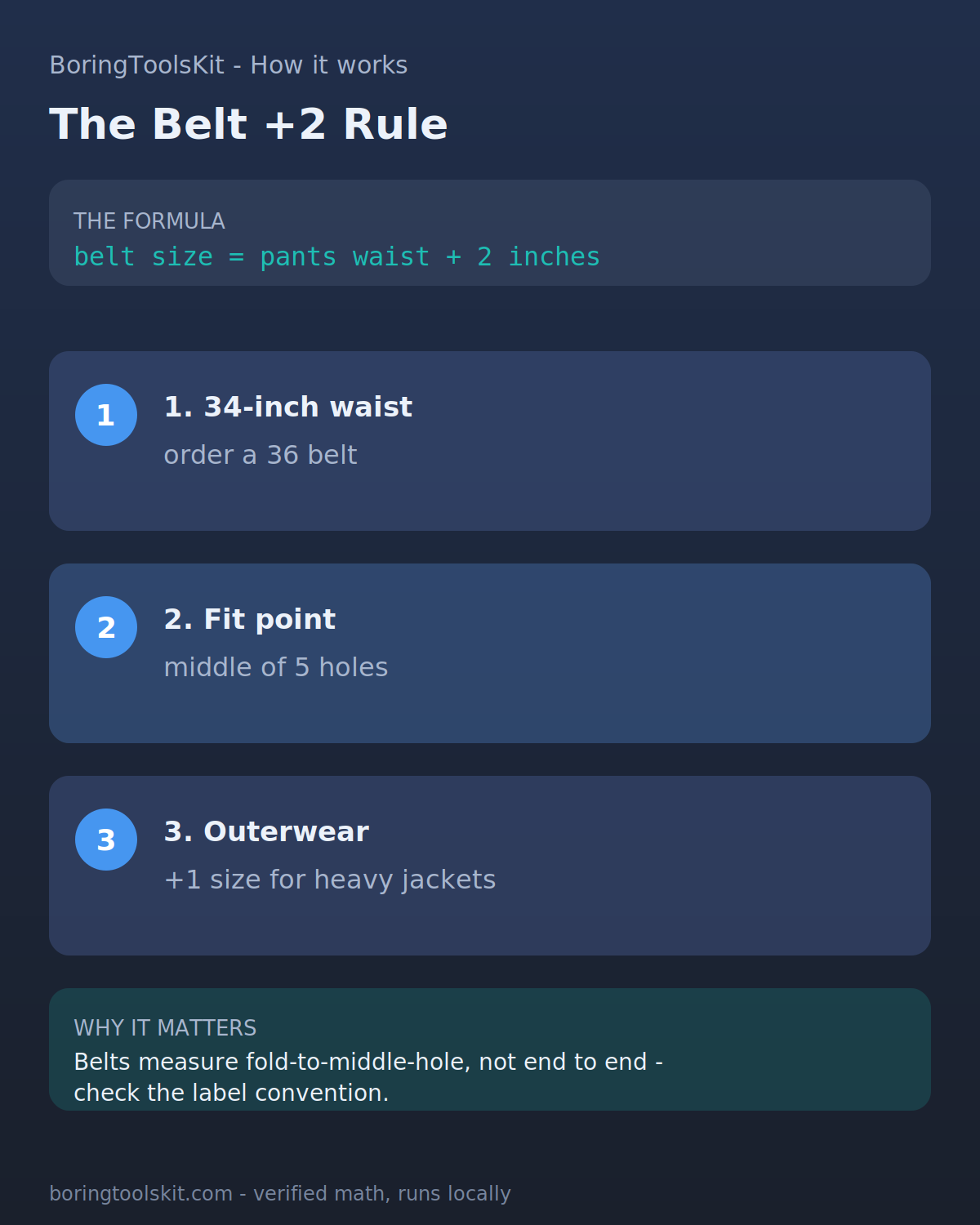
- Belt length is measured from the buckle fold to the middle hole, not end to end.
- Some brands sell 'actual strap length' instead — check which convention the label uses.
- A 5-hole belt gives roughly 4 inches of adjustment, 1 inch per hole.
How this calculator works
Formula
Belt size convention: pants waist size + 2 inches of strap to reach the buckle, and the fit point is the middle of 5 holes. A 34-inch waist takes a 36 belt measured from fold to middle hole.
Sources
Sources support the method, terminology, or planning context. Editable assumptions remain your responsibility.
Assumptions to verify
- Manufacturer charts vary; conversion outputs are the standard-mapping midpoint.
- Measurements are body measurements unless the tool labels them as garment measurements.
- Between-size results round per the rule stated in the FAQ.
Frequently asked questions
Should I size up for a belt over a jacket?
Yes for heavy outerwear: +1 size. For everyday pants, the +2-inch rule already includes a shirt tucked in.
What if I fall between sizes?
Round the direction that matches use: clothing and shoes generally round up.
Cite this tool
BoringToolsKit. “Belt Size Calculator.” boringtoolskit.com/belt-size-calculator/ (reviewed 2026-09-20). Free to reference in articles, syllabi, and answer posts with a link.
Privacy: Inputs and results stay in this browser. Conversion runs locally in your browser; review the output before relying on it.
Worked example: from 34-inch waist to a 36-inch belt
Say your jeans measure 34 inches at the waistband. The calculator runs one operation: 34 + 2 = 36, so you buy a size 36 belt. Here is why the extra 2 inches is not padding. A belt is sized buckle-to-middle-hole, while pants are sized to fit your body. When you wear the belt, the leather runs the full circle of your waist plus the length consumed by the buckle frame, tongue, and the leather folded back behind the buckle. On a typical 36 belt, that hardware and fold eats about 2 inches, which is exactly the gap between a 34 trouser waist and a 36 belt tag.
The margin works in both directions. On a size 36 belt the usable range from first hole to last hole is usually about 4 to 5 inches of strap length. With the belt set on the middle hole, you can tighten roughly 2 inches or loosen roughly 2 inches before you run out of holes. So the 34-inch buyer gets effective coverage from about a 32-inch to a 38-inch trouser waist on the same strap.
Change the input and the output moves one for one. Waist 28 gives 30. Waist 41 gives 43. Waist 60, the top of the accepted range, gives 62, and the calculator still returns a size. Waist 19 or 61 is rejected with a prompt to stay inside 20 to 60, because outside that band the plus-2 rule stops matching how belts are actually cut.
Where the plus-2 rule breaks down
The rule assumes your trouser waist measurement matches the size printed on the tag. It often does not. Vanity sizing means many 34 jeans actually measure 36 to 37 inches at the waistband. If you enter the tag size 34 but the real waistband is 37, the computed 36 belt will sit on its tightest hole or not close. Measure the waistband of the pants you will wear the belt with, not the number on the label, before you trust the result.
Belt styles change the offset too. A wide casual belt with a thick buckle can consume 2.5 to 3 inches, which makes the computed size feel snug. A slim dress belt with a small frame might use only 1.5 inches, leaving you on the loosest holes. The plus-2 figure is an average across those designs, not a guarantee for either extreme.
Two boundary cases worth knowing. At the 60-inch cap, the result is 62, but many retailers stop their size run at 56 or 58, so you may need a brand's extended line and the offset there is often 2.5 inches rather than 2. At the 20-inch floor, the result is 22, a children's size, and kids belts are frequently sized by age instead of inches, so the numeric output may not map to what the store stocks. The calculator gives the correct inches; the shelf does not always speak the same language.