Barbed Wire Fence Materials Calculator
The classic cattle fence: barbed wire strands on line posts with braced corners. Enter your run, strands, and post spacing to get wire rolls, posts, and corner hardware.
What does this tool do?
Barbed Wire Fence Materials Calculator computes the result directly in your browser — The classic cattle fence: barbed wire strands on line posts with braced corners. Enter your run, strands, and post spacing to get wire rolls, posts, and corner hardware. Nothing you enter is uploaded or stored.
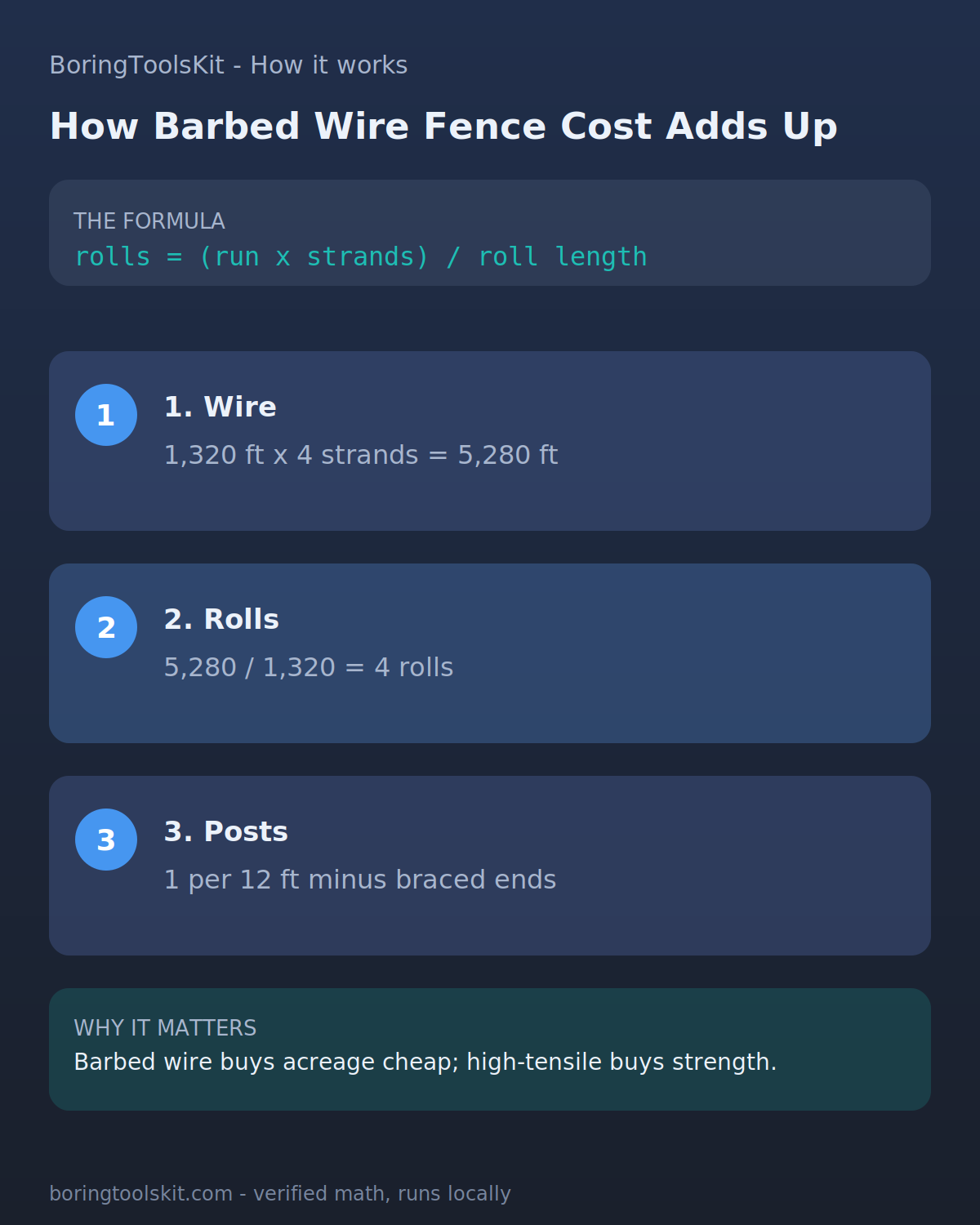
Formula: wire = run × strands; rolls = ceil(wire ÷ roll length). Line posts = run ÷ spacing (T-posts typically 12-16 ft apart); corner/end posts + 2 H-brace assemblies per direction change (each brace $75-150 in 2026 materials, per FenceCalc). Use: this counts materials, not labor — add installation at roughly $1-$2/ft and verify against a real supplier quote before purchasing.
How this calculator works
Formula: wire = run × strands; rolls = ceil(wire ÷ roll length). Line posts = run ÷ spacing (T-posts typically 12-16 ft apart); corner/end posts + 2 H-brace assemblies per direction change (each brace $75-150 in 2026 materials, per FenceCalc). Use: this counts materials, not labor — add installation at roughly $1-$2/ft and verify against a real supplier quote before purchasing.
Worked example
A quarter-mile run (1,320 ft), 4 strands, posts every 12 ft: 109 line posts plus end/corner bracing, 5,280 ft of wire = 4 quarter-mile roll(s) per strand set.
What Shapes Your Barbed Wire Materials List
Two multiplications set the wire math. The calculator takes your fence run in linear feet, multiplies by your strand count (4 is standard for cattle, 5 for high-pressure runs), and divides by the roll length, which is typically 1,320 ft. A 1,320 ft run at 4 strands needs 5,280 ft of wire, so you round up to 4 full rolls. Length and strands drive the roll total; spacing does not.
Post count comes from the run divided by your spacing, with 12 to 16 ft the typical range for T-posts. Corners and direction changes are separate line items: each corner in the count field adds an H-brace assembly, and braces ran $75 to $150 each in 2026 materials per FenceCalc. A longer run raises linear costs, but every added corner raises them in a fixed jump, not by the foot.
Getting The Most From Your Inputs
Start with the roll length field. A typical barbed wire roll covers 1,320 ft, but check the actual length on your supplier's listing before you order, because a shorter roll changes the total. Count your corners honestly on a map or walk; forgetting one skips its H-brace assembly and corner post. Keep line post spacing in the 12 to 16 ft band instead of stretching it to trim costs.
Remember the estimate covers materials only. Installation labor adds roughly $1 to $2 per foot on top of the parts list, and a 1,000 ft run lands around $690 to $1,370 in materials before labor and gates. Braces are where corner counts sting, at $75 to $150 each in 2026 materials. Before purchasing, take the list to a supplier and compare it against a real quote.
FAQ
How much barbed wire do I need?
Multiply your run length by the number of strands. For 1,320 ft at 4 strands that is 5,280 ft of wire, or 4 rolls at 1,320 ft per roll.
How far apart should fence posts be?
Line (T-) posts for barbed wire are typically 12-16 ft apart. Corner and end posts must be set closer and braced — each direction change needs an H-brace assembly.
How much does a barbed wire fence cost?
In 2026 examples, installed barbed wire is about $1.50-$3.50 per linear foot. Materials alone (wire, posts, braces) for 1,000 ft run roughly $690-$1,370, before labor and gates.
Figures are editable example defaults for planning, not guarantees. Fence material, labor, and installation costs vary by region, terrain, and year — verify with local suppliers, your NRCS office for EQIP cost-share, and a fencing contractor before committing to a project.