457(b) Retirement Calculator
The 457(b) deferred-compensation plan is one of the best-kept retirement secrets: no 10% early-withdrawal penalty like a 401(k). This estimates your account growth and retirement income.
What does this tool do?
457(b) Retirement Calculator computes the result directly in your browser — The 457(b) deferred-compensation plan is one of the best-kept retirement secrets: no 10% early-withdrawal penalty like a 401(k). This estimates your account growth and retirement income. Nothing you enter is uploaded or stored.
What it is: a tax-deferred plan for state/local government and some nonprofit (501(c)(3)) employees. Key advantage: no 10% early-withdrawal penalty for distributions before 59½ (if you separate from service), unlike 401(k)s and IRAs — valuable for planned early retirement. Limits: $23,500 elective deferral in 2025, with a $7,500 catch-up for age 50+, and a special 3-year catch-up option near retirement. Note: contributions are tax-deferred but withdrawals are ordinary income.
How this calculator works
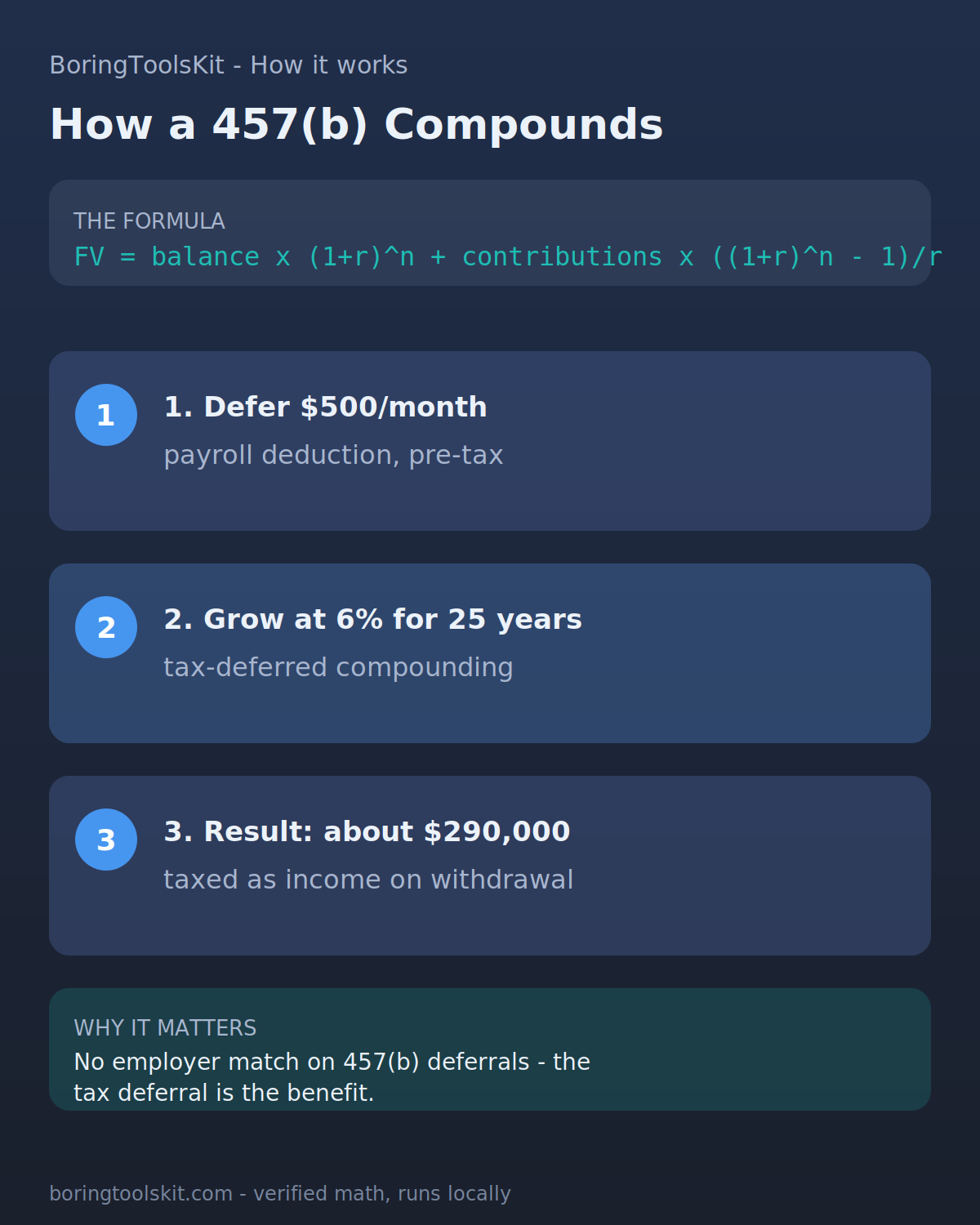
Growth mirrors a tax-deferred IRA: FV = balance x (1+r)^years + contribution x ((1+r)^years - 1)/r. No employer match exists on 457(b) employee deferrals.
Worked example
$500/month at 6% for 25 years grows to about $290,000, all tax-deferred until withdrawal.
FAQ
What is a 457(b) plan?
A tax-deferred retirement plan offered to state/local government and some nonprofit employees. Contributions lower current taxable income and grow tax-deferred until withdrawal.
How is a 457(b) different from a 401(k)?
The 457(b) has no 10% early-withdrawal penalty for distributions after you separate from service — a real advantage for retiring before 59½. Contribution limits are similar.
Can I have both a 457(b) and a 401(k)?
Yes — if you work for an employer that offers both, you can contribute to each up to its own limit, effectively doubling your tax-deferred savings.
Figures are editable example defaults for modeling, not quotes or advice. Financial, tax, and medical outcomes vary with your situation — verify with a qualified professional (CFP, CPA, tax advisor, or veterinarian).